
INSTALLATION & ADJUSTMENT
How to adjust a door closer: closing speed and latching speed
Most doors that slam or fail to latch do not need a new closer. They need a quarter turn on the right valve.
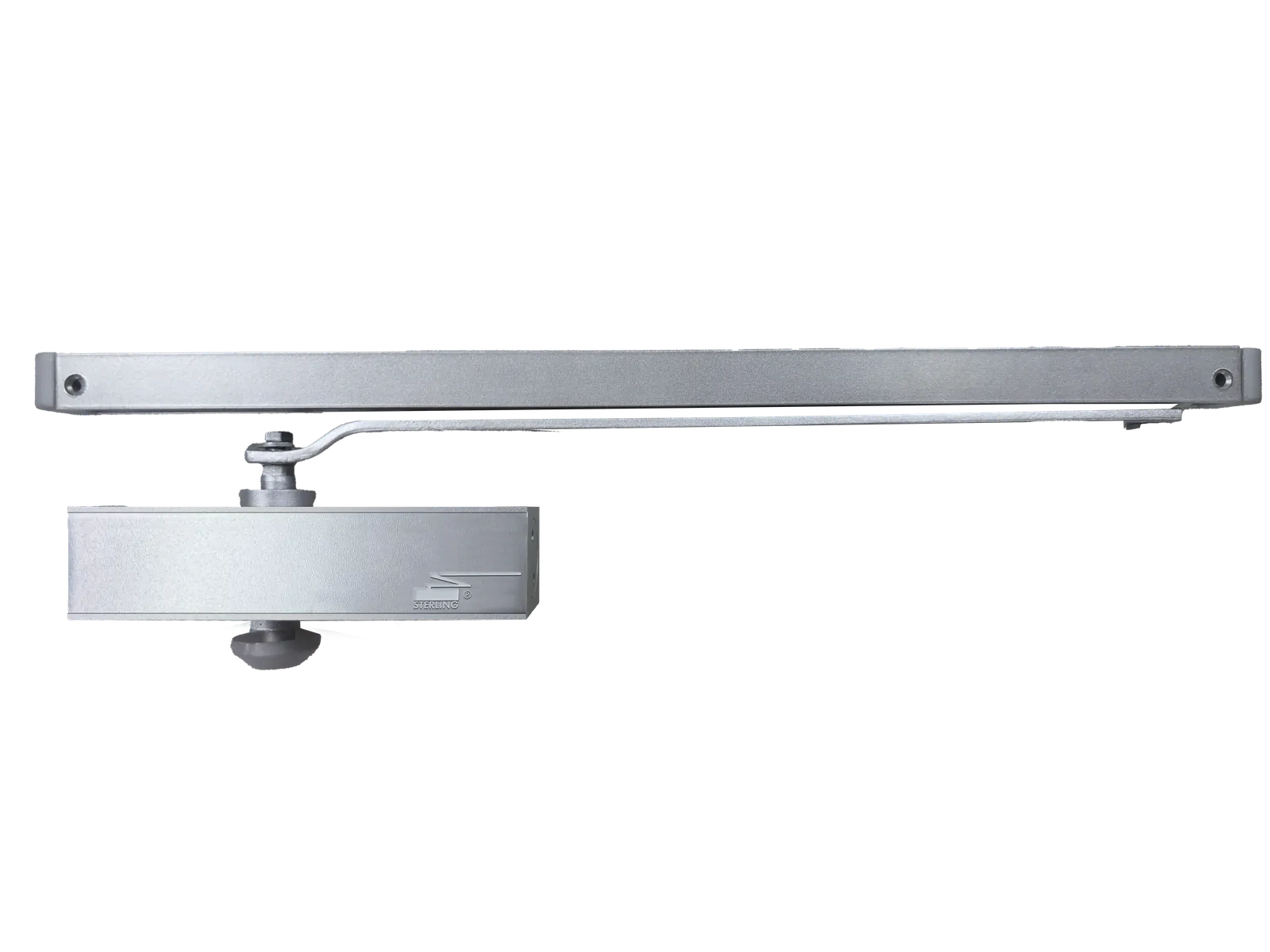
A door closer that slams, or one that stalls short of the frame and leaves the door ajar, is usually a closer that has never been set up properly rather than a faulty one. The adjustment takes a screwdriver and a few minutes.
Two valves, two parts of the swing
Sterling's door closers use two-speed control, and the two speeds cover different arcs of the door's travel. The valves are small screws on the closer body, normally marked to indicate which is which.
The closing speed valve controls the main sweep, from fully open down to roughly 10 to 15 degrees from the frame. This is the part of the swing people notice, and it is what determines whether the door feels controlled or violent.
The latching speed valve controls the last stretch into the frame. It exists because the two ends of the swing need opposite things: the sweep should be slow enough to be safe, but the final few degrees need enough speed to drive the latch bolt into the keep and compress any seal. A door closed slowly all the way through will rest against the frame without latching.
Which way to turn
On a hydraulic closer the valves meter oil flow, so tightening restricts flow and slows that part of the swing, while loosening allows more flow and speeds it up. Clockwise slows it down; anticlockwise speeds it up.
Work in eighth turns. These valves have a very short useful range and an eighth of a turn produces a clearly noticeable change, where a half turn usually overshoots. Adjust, let the door close fully, watch it, adjust again.
The mistake that ruins a closer
Never unscrew a speed valve all the way out. The valve is sealing pressurised hydraulic fluid, and backing it out past its travel lets the oil escape. A closer that has lost oil cannot be refilled in the field and is scrap. If a valve is already near the end of its range and the door still is not behaving, the problem is elsewhere: the power size, the arm setting, or the door itself.
A working sequence
- Open the door fully and let it close on its own, watching the whole swing. Decide which part is wrong: the main sweep, the final few degrees, or both.
- Set the closing speed first. Aim for a sweep that takes several seconds and never feels like it is running away. Adjust in eighth turns and test after each one.
- Set the latching speed second. It should be quicker than the sweep, enough to throw the latch positively, without a bang.
- Check it latches from a small opening, not just from wide open. Push the door to about 15 degrees and release. If it stops short, the latch speed is too slow or the closing force is set too low.
- Check the opening force by hand. If the door is hard work to open, the arm is set harder than it needs to be. The right setting is the lowest one that still latches reliably every time.
When adjustment is not the answer
If the door will not latch even with the latch speed opened up, the closer may simply be undersized for the leaf, so it is worth checking the door's width and mass against the model's EN power size band before doing anything else. External doors are the usual culprits, because wind and stack pressure work against the closer at exactly the point where it has least leverage.
If the door binds or drags at a particular point in the swing, the problem is alignment rather than hydraulics: check the hinges, whether the frame is square, and whether the arm is fouling anything.