How to install a concealed door closer: door preparation
Covers DC 2700 and DC 2800
A concealed closer sits inside the leaf, so the door decides whether it can be fitted at all. What to check before the pocket is cut, how to cut it, and how to fit and commission the DC 2700 and DC 2800.
- Written by
- Sterling
- Published
- Updated
Fitting a concealed door closer is mostly door preparation. The closer itself goes in last; the time and the risk are in the pocket cut to receive it and in the checks that come first. This guide covers that work for the two Sterling concealed models, the DC 2700 and the DC 2800. If you are still deciding whether concealed is the right type, the guide on surface-mounted versus concealed door closers covers that choice; this one assumes it is made.
Where the closer sits
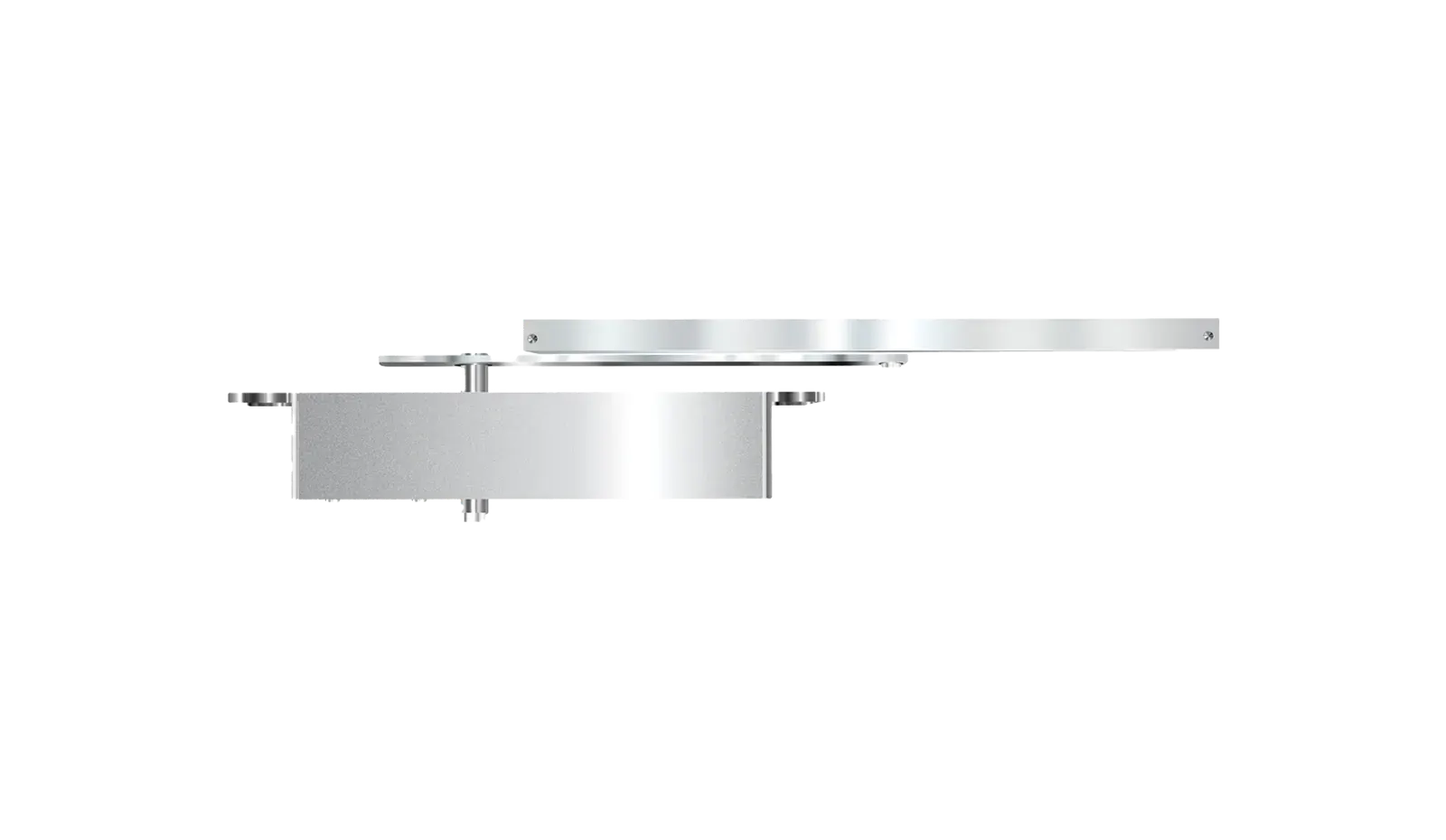
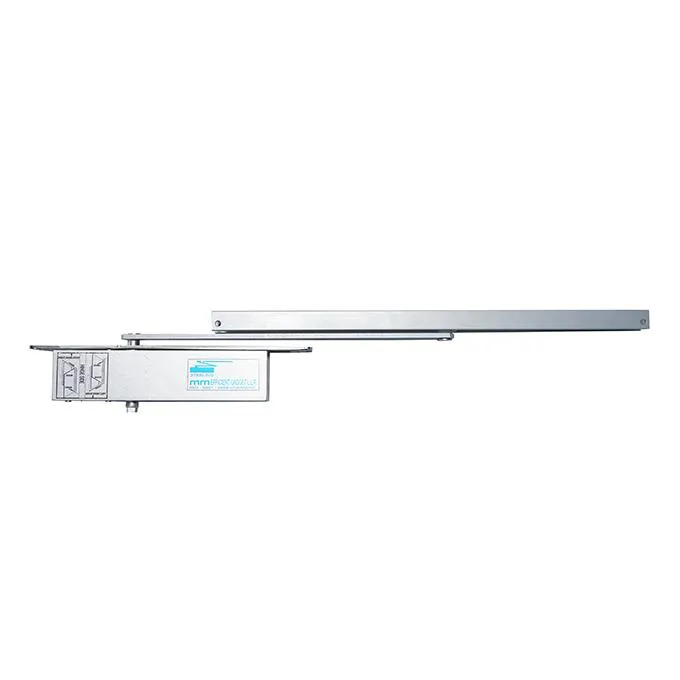
Both Sterling concealed closers are pelmet type: the body is morticed into the top edge of the door leaf and the arm reaches up to the frame head, so with the door closed nothing shows on either face. Because the body lives inside the leaf, both models carry a minimum door thickness.
The DC 2700 housing is 210 x 28 x 50 mm and suits wooden doors from 32 mm thick. The DC 2800 housing is 225 x 32 x 50 mm and suits wooden doors from 38 mm thick. At those minimums the arithmetic is tight: the body alone takes 28 mm of a 32 mm leaf, leaving 4 mm in total for the two cheeks of the pocket before any working clearance, and 6 mm on the DC 2800. That is why the pocket has to be centred and cut square, and why a thicker leaf is easier work.
Check the door before anything is cut
Thickness. Measure the actual leaf at the top edge where the pocket will go, not the nominal size on the door schedule. A finished leaf can come in under nominal, and a 31 mm leaf is not a 32 mm leaf.
Construction. The brochure rates both models for wooden doors; in practice the pocket has to land in solid timber. A hollow-core door gives the body nothing to sit in and the fixings nothing to hold, and an engineered leaf may have a top rail too shallow for a 50 mm high body. For new doors, tell the door manufacturer which closer is going in and have them confirm the top rail is solid, deep enough and free of joints where the pocket falls. For existing doors, drill a small test hole where the pocket will go before committing.
Weight, width and height. The weight and width limits in the table below apply together: a light door wider than 970 mm is outside the rating. The guide on measuring a door before choosing a closer covers how to take leaf width and mass. The brochure prints no maximum door height for either model; for an unusually tall leaf, ask first.
Certification and variant. Both concealed models are ISI marked to IS 3564:1995 under BIS licence CM/L 7700126309, so a specification that calls for an ISI marked closer is met by either. No CE marking is stated for them: if the specification calls for CE marking, that means a surface-mounted model (DC 1800 LA, DC 1820, DC 2000, DC 2600 or DC 2900) in the Sterling door closer range, settled before a door is cut. Hold-open is the HPA variant, a different unit chosen at ordering; on a fire or smoke door it is a question for the fire consultant.
| Specification | DC 2700 | DC 2800 |
|---|---|---|
| Housing (L x W x H) | 210 x 28 x 50 mm | 225 x 32 x 50 mm |
| Minimum door thickness | 32 mm | 38 mm |
| Door weight | Up to 60 kg | Up to 80 kg |
| Door width | Up to 970 mm | Up to 970 mm |
| Closing force | EN 2-3, by preloading the arm | EN 2-4, by preloading the arm |
| Door material | Wooden doors | Wooden doors |
| Variants | DC-2710 PA; DC-2720 HPA, hold-open 10 to 90 degrees | DC-2810 PA; DC-2820 HPA, hold-open 10 to 90 degrees |
| Cycle test | 3,00,000 cycles | 4,00,000 cycles |
The template sets the mortice, not the housing
Concealed closers are fitted to the manufacturer's template or installation drawing, and the mortice is cut to it. Check that one is in the box before the door goes to the workshop. The housing dimensions above are for checking that the leaf can take the body; they are not for marking out. A fitting drawing normally sets what the housing figures do not: the pocket size with its working clearance, the distance from the hinge edge, the fixing positions and the setting out on the frame side. The guide on door closer installation mistakes covers what ignoring the template does to a surface closer; on a concealed unit the pocket cannot be moved afterwards.
If there is none, or the doors go to the workshop ahead of the hardware, get the drawing first: this site does not publish one for the concealed models, so ask Sterling for the drawing, naming the model and variant.
Cutting the mortice
Cut the pocket with the leaf flat on a bench. The usual method is a plunge router with a straight cutter running against a fence or a jig clamped to the leaf, taking the depth in several passes, with the ends squared off by hand with a chisel. Whatever the tool, the aims are the same:
- Centre the pocket on the thickness of the leaf so both cheeks are equal, measuring from both faces.
- Cut the sides parallel and the ends square. A pocket that tapers grips the body at one end and leaves it loose at the other.
- Take the depth from the drawing and go no deeper, with a flat floor so the body sits without rocking.
- Clear every chip before test fitting; debris under the body means a closer that shifts later.
Test fit the body dry. It should go in under hand pressure and come out without levering. If it has to be driven, ease the cheeks a little at a time and check after each pass. If it rattles, the pocket is oversize and the fixings will carry load they were not meant to.
Fitting the body and the arm
The body is held by its chrome-plated mounting strip, which has to bed flat on the top edge of the leaf. Drive the fixings firm and seated, and no further. Both models suit left and right hand door opening, so there is no handed unit to order, but the body has an orientation within the pocket: check it against the drawing, and know how the speed valves will be reached once the door is hung.
Set out the frame side from the same drawing with the door hung, and swing it through its full arc to confirm the arm clears the frame, the stop and any seal before the last fixing goes in.
Closing force is set by preloading the arm, across EN 2-3 on the DC 2700 and EN 2-4 on the DC 2800. Preload only as far as the door needs to close and latch against its seals; extra force adds effort for users and load on the fixings in the top edge of the leaf.
Commissioning
Both models have two-speed control: a closing speed for the main sweep and a latching speed for the last few degrees into the frame. The procedure is the same as for a surface closer and is covered in the guide on adjusting a door closer's speed and latching: eighth turns, closing speed first, latching second, and never back a valve out past the end of its travel.
Run the latching and opening force checks from that guide with any seals fitted, because a new seal adds resistance in the last few degrees. On a hold-open variant, confirm it holds within the 10 to 90 degree range and closes normally once released.
All of this is simpler with the leaves still in the joinery shop, which is the case for specifying concealed closers at design stage. A retrofit means taking the door down and cutting into a finished edge, and only where the leaf passes the checks above; otherwise a surface-mounted closer is the right answer.
Questions
Can a concealed door closer be fitted to a hollow-core door?
Not as built. A hollow-core leaf has no solid timber where the pocket goes. A door made with a solid top rail, deeper than the 50 mm body and at least the model's minimum thickness, can take one. Otherwise fit a surface-mounted closer.
Can I mark out the mortice from the housing dimensions?
No. They only tell you whether the leaf can take the body. The mortice is cut to the manufacturer's template or drawing, which sets the clearance, the position from the hinge edge and the fixings. If there is none in the box, ask Sterling for the drawing before cutting.
Which concealed model should I fit?
Decide by weight, width and thickness together. If the leaf is near the top of the DC 2700's 60 kg range and is at least 38 mm thick, the DC 2800 covers up to 80 kg across EN 2-4 and leaves adjustment in hand.