
TROUBLESHOOTING & MAINTENANCE
How long does a door closer last?
The honest answer is that it depends entirely on how often the door moves, which is why closers are rated in cycles rather than years.
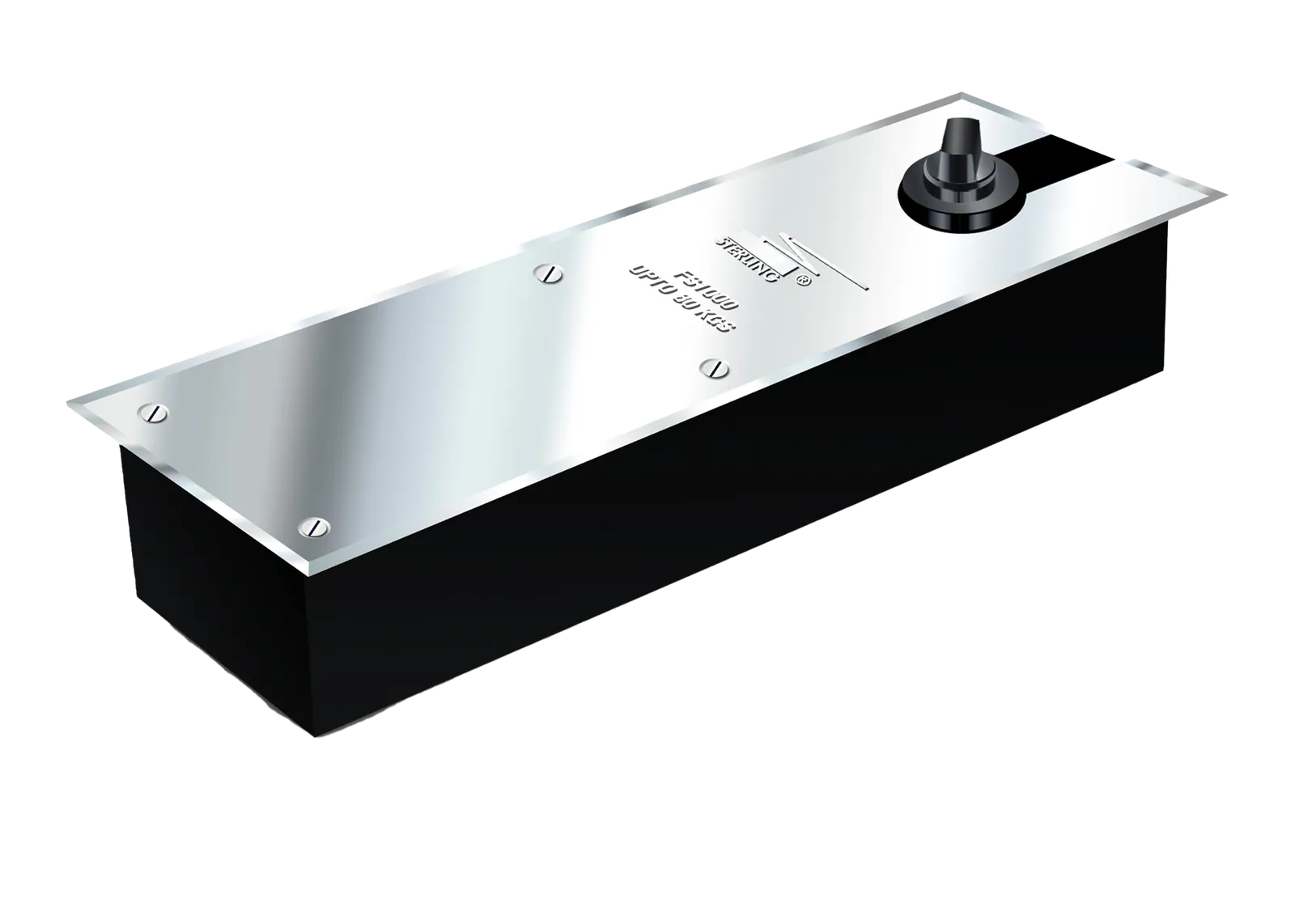
Ask how long a door closer lasts and the useful answer is a question back: how many times a day does the door move? Closers wear by use, not by age, which is why the industry rates them in cycles.
What the cycle rating means
One cycle is one full open and close. The benchmark figure is 500,000 cycles, or five lakh, which is the durability test requirement in EN 1154 and the figure Sterling's door closers and floor springs are tested to.
Turning that into years is arithmetic on your own traffic:
| Door use | Cycles per day | Approximate service life |
|---|---|---|
| Internal office or meeting room | 20 | Well over the life of the fit-out |
| Departmental or corridor door | 100 | Around 13 years |
| Busy building entrance | 200 | Around 7 years |
| Retail or hospital entrance | 500 | Under 3 years |
The pattern is what matters rather than the precise figures. On a quiet internal door the cycle rating is effectively irrelevant and the closer will outlast the decor. On a main entrance it sets a replacement interval you are better off planning for than discovering.
What shortens it
Several things take a closer well below its rating, and most are avoidable.
Propping the door open. Wedging a door against a closer that is trying to shut it holds the mechanism under constant load. If a door genuinely needs to stay open, it needs a hold-open device rather than a wedge. Both Sterling floor springs have a built-in hold open at 90 degrees, and the concealed DC 2800 holds from 10 to 90 degrees.
Slamming. A closer whose closing speed is set too fast lets the door arrive at the frame with energy that has to go somewhere: into the latch, the frame and the closer's own linkage.
Misalignment. A dropped hinge, a frame out of square or a swollen leaf makes the closer work against friction through part of the swing, every cycle.
Loose fixings. A body working against a fastening that has started to move will enlarge its own fixing holes, and the load gets worse as it goes.
The wrong power size. A closer running at the top of its range to move a door it is marginal for is working harder every cycle than one sized correctly with adjustment in hand.
Signs it is near the end
Oil around the body is terminal. A hydraulic closer is a sealed pressurised unit and a leak means a failed seal. It cannot be topped up on site, and once the fluid is gone so is the damping.
Short of that, watch for a door that has become inconsistent: latching some days and not others, or needing the speed valves adjusted more often than it used to. A closer that no longer holds a setting is telling you something.
The maintenance that actually helps
Closers need very little, and a short annual check per door catches most of what goes wrong. Look for oil around the body. Confirm the door still latches when released from about 15 degrees, not just from wide open. Confirm the opening force is still comfortable. Check the arm and body fixings are tight, and check the hinges while you are there.
Five minutes a door, once a year, is the difference between replacing closers on a schedule and replacing them after a complaint.