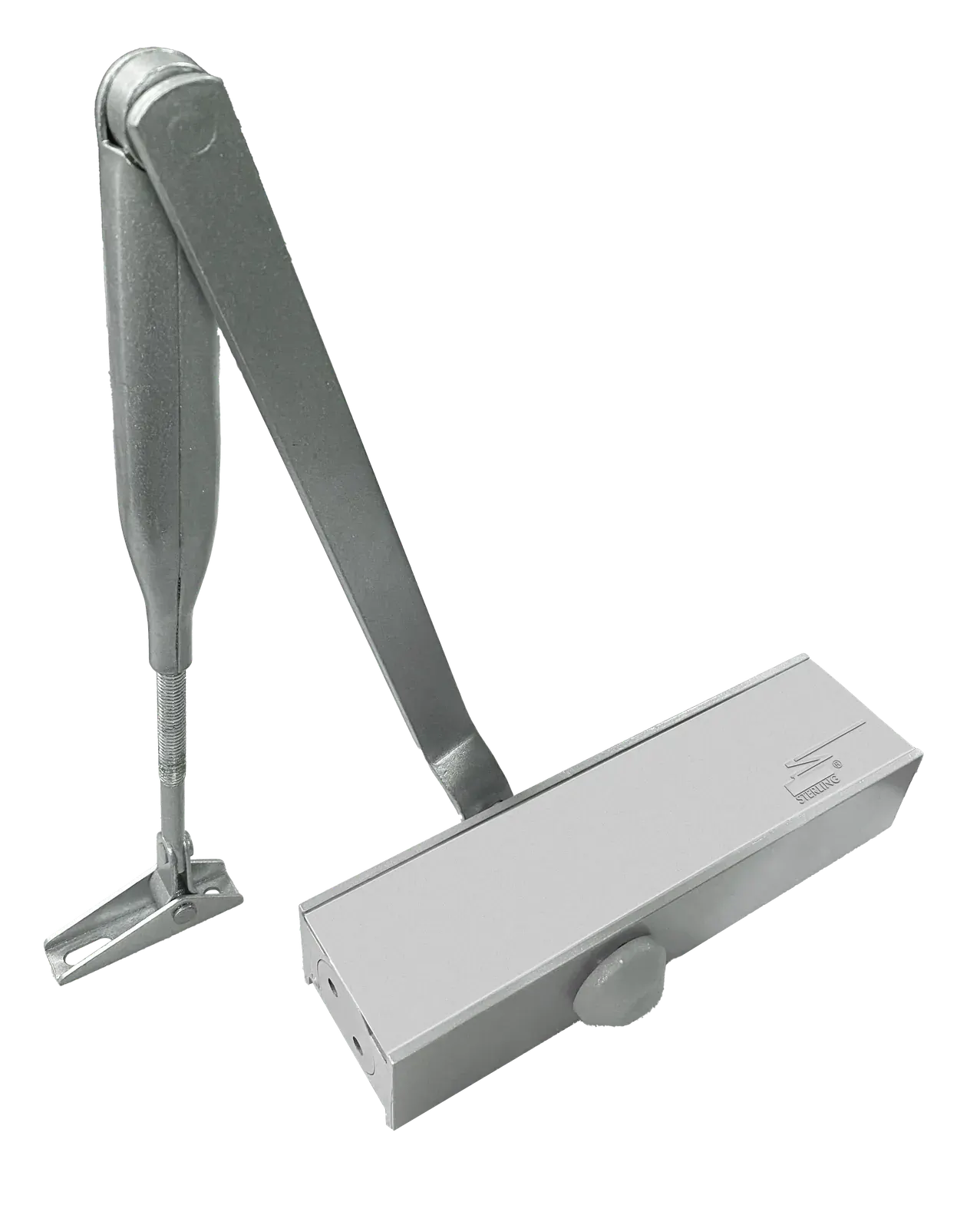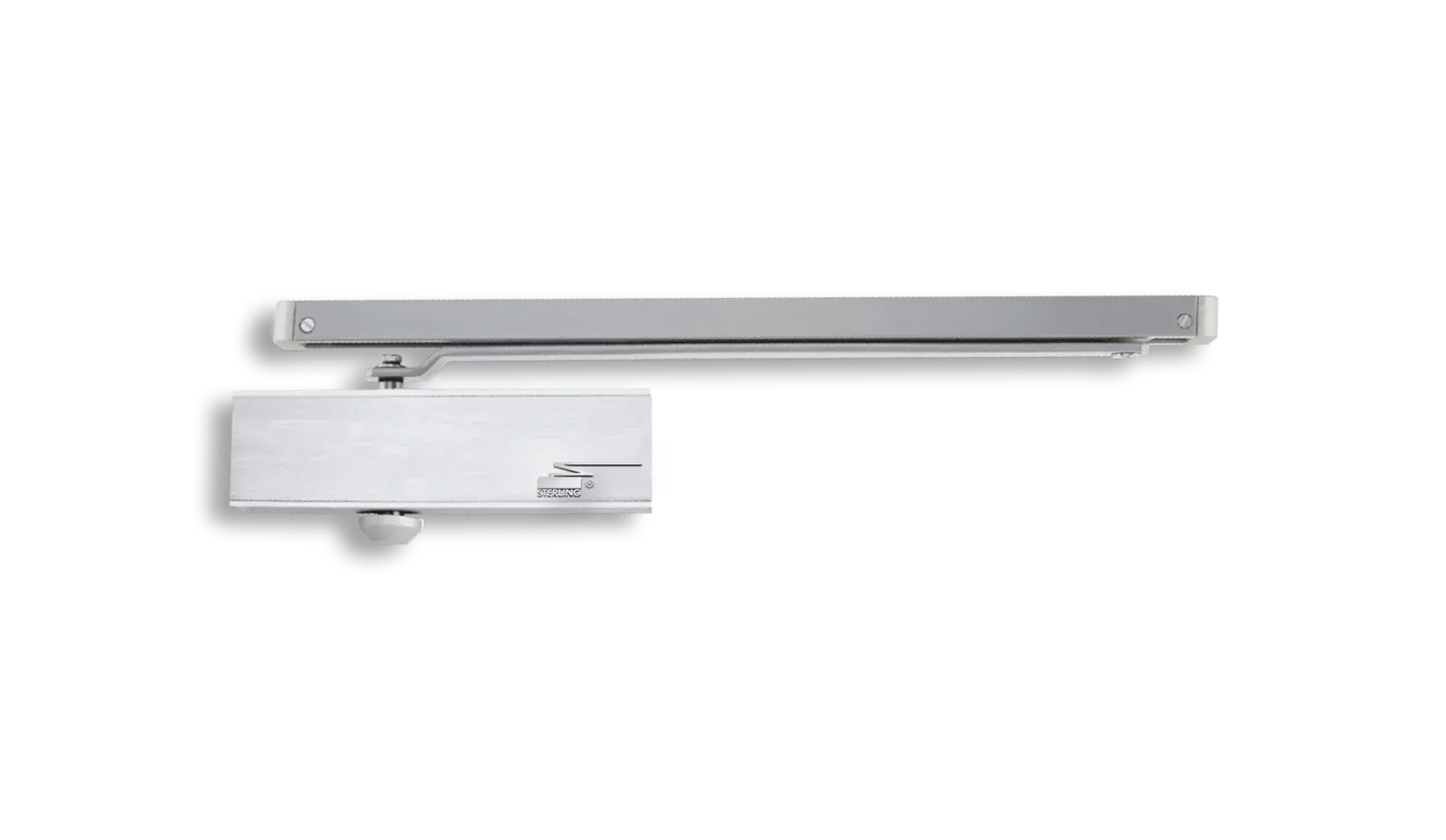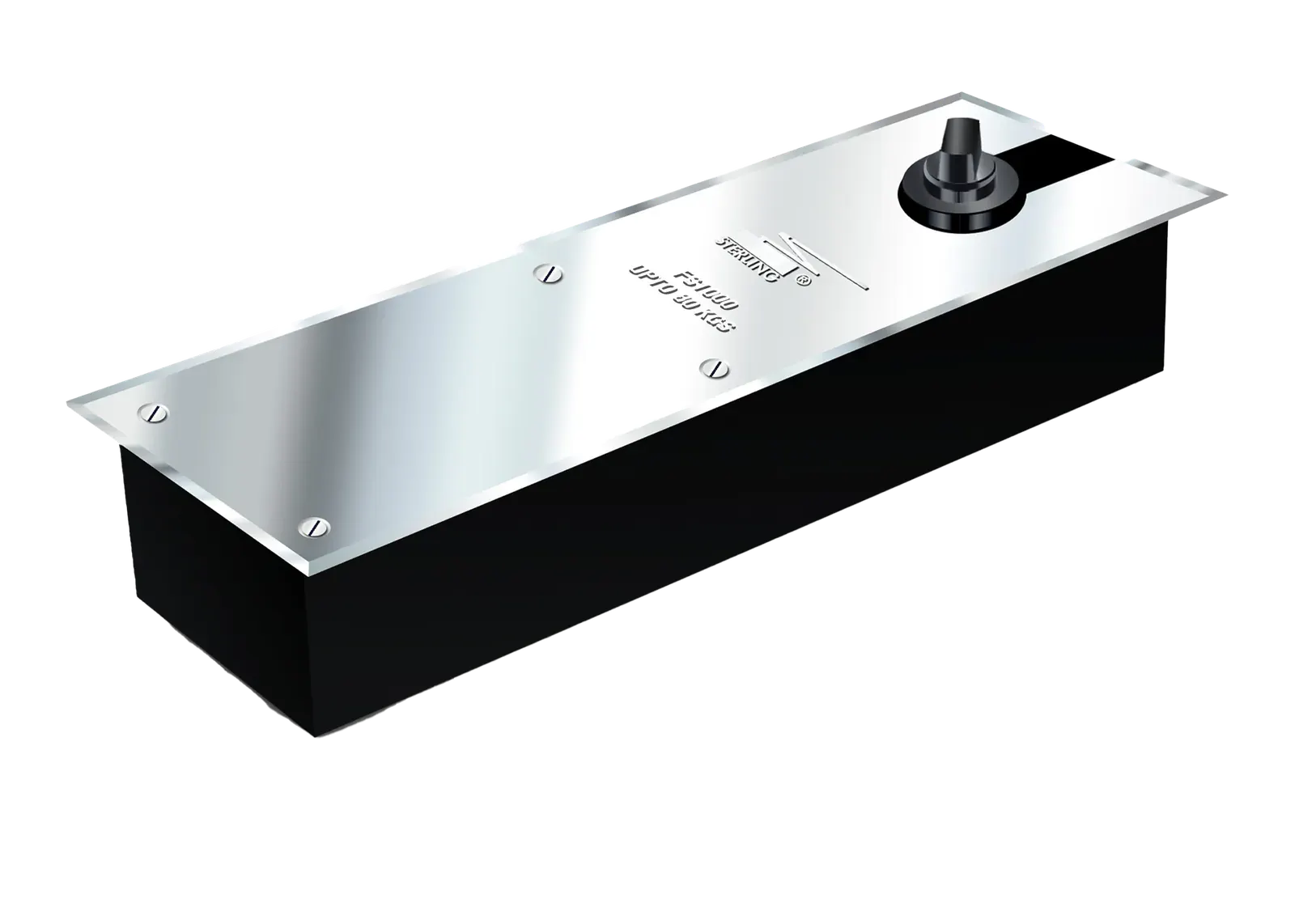
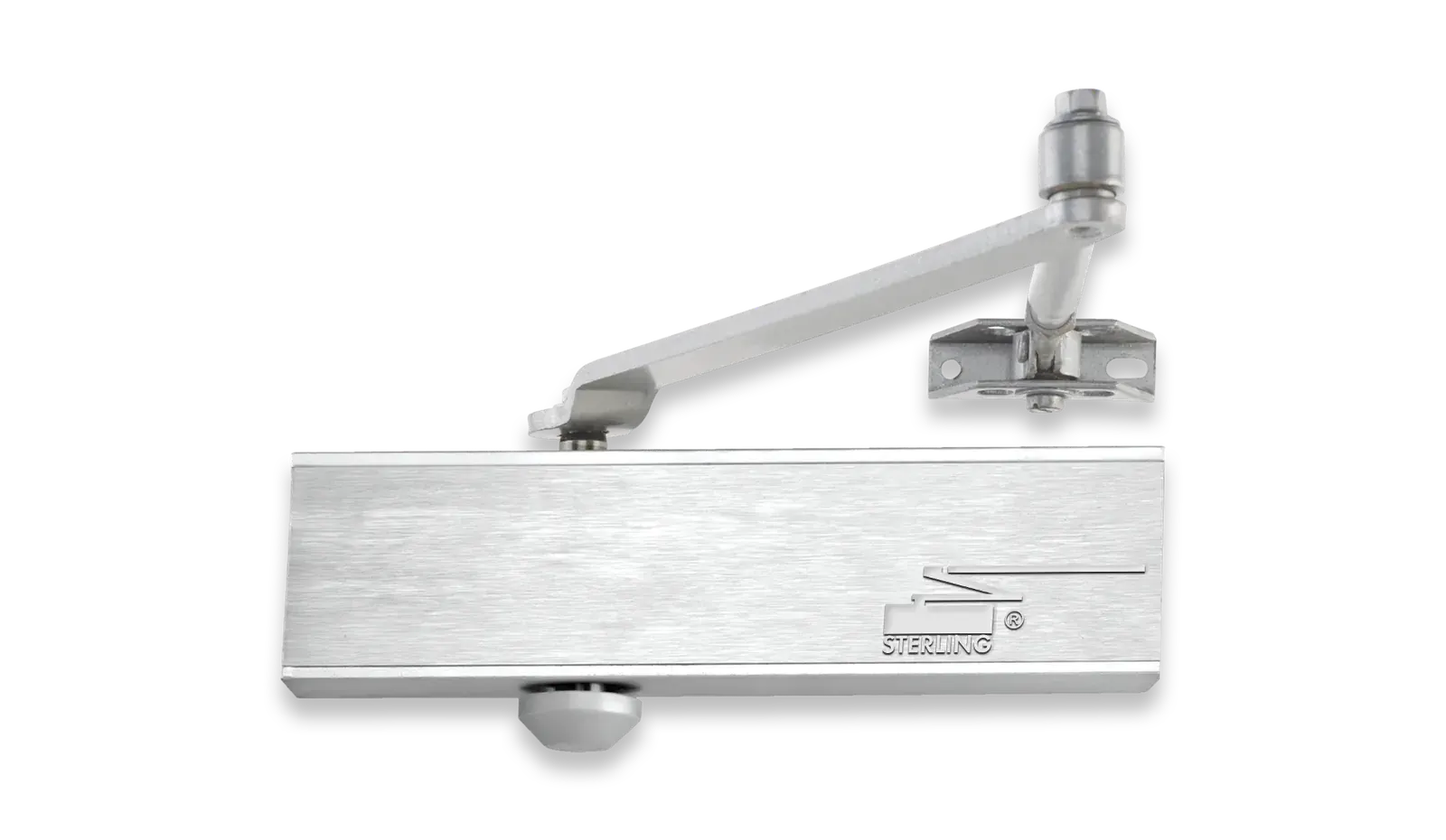
Door closer maintenance checklist for facility managers
Covers 8 checks
Most closer faults can be caught in five minutes at the door, if someone is looking. A door register, a short table of checks and a record per visit turn complaints into scheduled work.
- Written by
- Sterling
- Published
- Updated
A door closer rarely fails without warning. It slams for a few weeks, or stops latching on windy days, or leaves a smear of oil on the door face, and then someone logs a complaint. A maintenance routine exists to see those signs first. This guide is for whoever is responsible for a building's doors: how often to look, what to look at, how to record the result, and when a closer should be adjusted, repaired or replaced.
How often to inspect
No service interval is published on this site; ask Sterling whether the installation sheet for your model gives one. The cycle figures on the product pages are durability test results, not a maintenance schedule: the DC 2000, DC 2600 and DC 2900 are each tested for 5,00,000 cycles in a government-approved lab. What follows is general practice, not a manufacturer's requirement.
A short check per door once a year is the usual baseline, and it is the routine the Sterling guides on how long a door closer lasts and common door closer faults already recommend. The service life table in the first of those guides puts a 5,00,000 cycle rating at around seven years for a door used 200 times a day, and under three years at 500, so a main entrance or a busy corridor door deserves a look every few months.
Two triggers sit outside the calendar. A newly fitted closer should have its fixings checked again a few weeks after installation, because screws in timber settle. On fire doors the inspection interval is set by the fire regulations that apply to the building; ask the fire consultant or the authority having jurisdiction what they require. If a maintenance contract needs a documented interval or warranty terms, agree them with the supplier in writing, because neither is published on this site.
Set up a door register first
A checklist is only useful against a list of doors. Before the first round, record for each door:
- A door reference and its location.
- Leaf width and, where known, leaf mass. These are what the closer's EN power size was chosen against.
- The closer model and arm type, from the installation record, the purchase record or the label on the unit. On the Sterling range that is the model and order code, for example DC-2000-LA-PU SR.
- Whether the door is a fire door, an external door or a hold-open door.
The inspection needs a stepladder, a screwdriver or key to suit the speed valves, the spanner or key that fits the arm fixings, a torch, a clean rag and the record sheet.
The inspection table
Print this and work through it door by door. Each row is one check with a pass condition and the action if it fails. Where the action is an adjustment, the guide on adjusting closing and latching speed covers which valve to turn and how far.
Scroll the table sideways for every column.
| Check | How to check | Pass | If it fails |
|---|---|---|---|
| Closing speed | Open the door fully and release it. Watch the main sweep. | A controlled sweep of several seconds that never runs away. | Slams or crawls: adjust the closing speed valve in eighth turns, testing after each. |
| Latching speed | Open the door to about 15 degrees and release it. | The latch engages every time, without a bang. | Stops short: open the latching valve slightly. If it is already near the end of its range, check the power size against the door. |
| Opening force | Open the door by hand from closed. | Comfortable for the people who use the door. | Hard to open: bring the arm setting down to the lowest force that still latches reliably. |
| Arm fixings | Push and pull the arm by hand. Check the body screws, the arm bracket and the arm pivots. | No movement at any fixing, no enlarged holes, and the arm sits square with the door closed. | Tighten. If a hole has enlarged, repair the leaf with an insert or a backing plate before refitting. |
| Oil leaks | Look at the body, around the valves and spindle, and at the door face and floor below. | Dry. | Any oil: replace the unit. A closer cannot be topped up on site. |
| Hold-open | On hold-open models, set the hold and release it. | Holds where set and releases cleanly. The DC 2600 holds from 10 to 90 degrees; Sterling floor springs hold at 90 degrees. | Does not hold or will not release: check the arm setting against the installation sheet. On a fire door, confirm hold-open is permitted at all. |
| Door alignment | Swing the door slowly through its arc, then open it fully. | No drag, rub or lift, and nothing in the arm's path. | Fix the hinge, frame or clearance first. Do not adjust the hydraulics to compensate for a door that binds. |
| Propping | Look for wedges, hooks or furniture holding the door open. | None. | Remove them, and where the door has to stay open, specify a hold-open device. |
Record the result
One line per door per visit: the date, who inspected, each check marked pass, adjusted or fail, what was adjusted and by how much, and anything left outstanding. Photograph any oil and keep the sheets.
The record matters more than any single visit. A closer that is adjusted at every round, or that needs its latching valve opened a little further each time, is no longer holding a setting, which is the end-of-life sign described in the service life guide. A door whose fixings loosen between visits has a fixing problem in the leaf, not a closer problem. If a fire inspector or a supplier asks how the door has been maintained, the history is the evidence.
Adjust, repair or replace
Sort every failed row into one of three outcomes before anyone orders anything.
Adjust covers closing speed, latching speed and opening force. Work in eighth turns, test after each, and never unscrew a valve beyond its travel; the adjustment guide linked above explains why.
Repair covers the door rather than the closer: hinges, the frame, floor clearance, enlarged fixing holes. Do these before touching the valves.
Replace is the answer to oil on the body, a cracked housing, a closer that will not hold a setting, or one that cannot latch the door with the latching valve at the end of its useful range. For a like-for-like swap, take the model from the register and match the EN band, door weight and door width. Sterling's surface-mounted models use universal mounting for left and right hand doors, so handing does not change the order. Where the original was ISI marked, which in the Sterling range covers all eight door closers under BIS licence CM/L 7700126309, the replacement should be too if the specification called for it. The full range is on the Sterling door closers page.
Doors that need more than the table
External entrances. Wind and the air pressure difference between inside and outside push on the whole leaf, so external doors are usually the first to stop latching. Inspect them more often, and if a replacement is due, consider one power size up. Where that means EN 4-5, the DC 2900 covers doors up to 100 kg and 1100 mm wide and is designed to withstand heavy wind pressure; it is ISI marked to IS 3564:1995 and CE marked.
Hold-open doors. A door found wedged open at every round is a door that needs a hold-open closer, such as the DC 2600, which holds from 10 to 90 degrees. On a fire door, any hold-open arrangement is a question for the fire consultant.
Floor springs. The same speed, latching and leak checks apply, but the unit is under the floor, so add the cover plate, the top pivot and the door's alignment on the spindle to the list. Both Sterling floor springs have left-right, front-back and top-bottom adjustment inside the box, and the FS 3000 has a load adjustment screw for doors from 90 to 120 kg. Their hold-open is fixed at 90 degrees, and both are BIS certified under CM/L 7700249814. Details per model are on the Sterling floor springs page.
Questions
How often should door closers be inspected?
Once a year per door is the usual baseline in general practice, with busy entrances looked at every few months and fire doors at whatever interval the applicable fire regulations set. No Sterling service interval is published on this site.
Does Sterling publish warranty terms?
Not on this site. If a maintenance contract or a tender needs them, ask for the terms in writing with the quotation.
Which Sterling closers can be adjusted from the front?
The DC 1820, DC 2000, DC 2600 and DC 2900 have speed adjustment on the front face of the body. The DC 1800 LA is also available with front control speed adjustment.