How to adjust a floor spring: speed, latching and alignment
Covers FS 1000 and FS 3000
This guide explains what the two speed valves, the 90 degree hold open and the three alignment adjustments inside the box each do, and the order to work through them when a door slams or will not close.
- Written by
- Sterling
- Published
A floor spring door that slams, stops short of closed or hangs out of line is nearly always a setting problem rather than a failed unit. Everything adjustable sits in the box under the cover plate, and the faults come down to the speed valves, the hold open or the alignment. This guide covers what differs from an overhead closer.
What is under the cover plate
A floor spring sits in a cement box in the floor. The door turns on a spindle that rises through the cover plate into a strap or patch fitting on the bottom of the leaf, with a top pivot on the same axis.
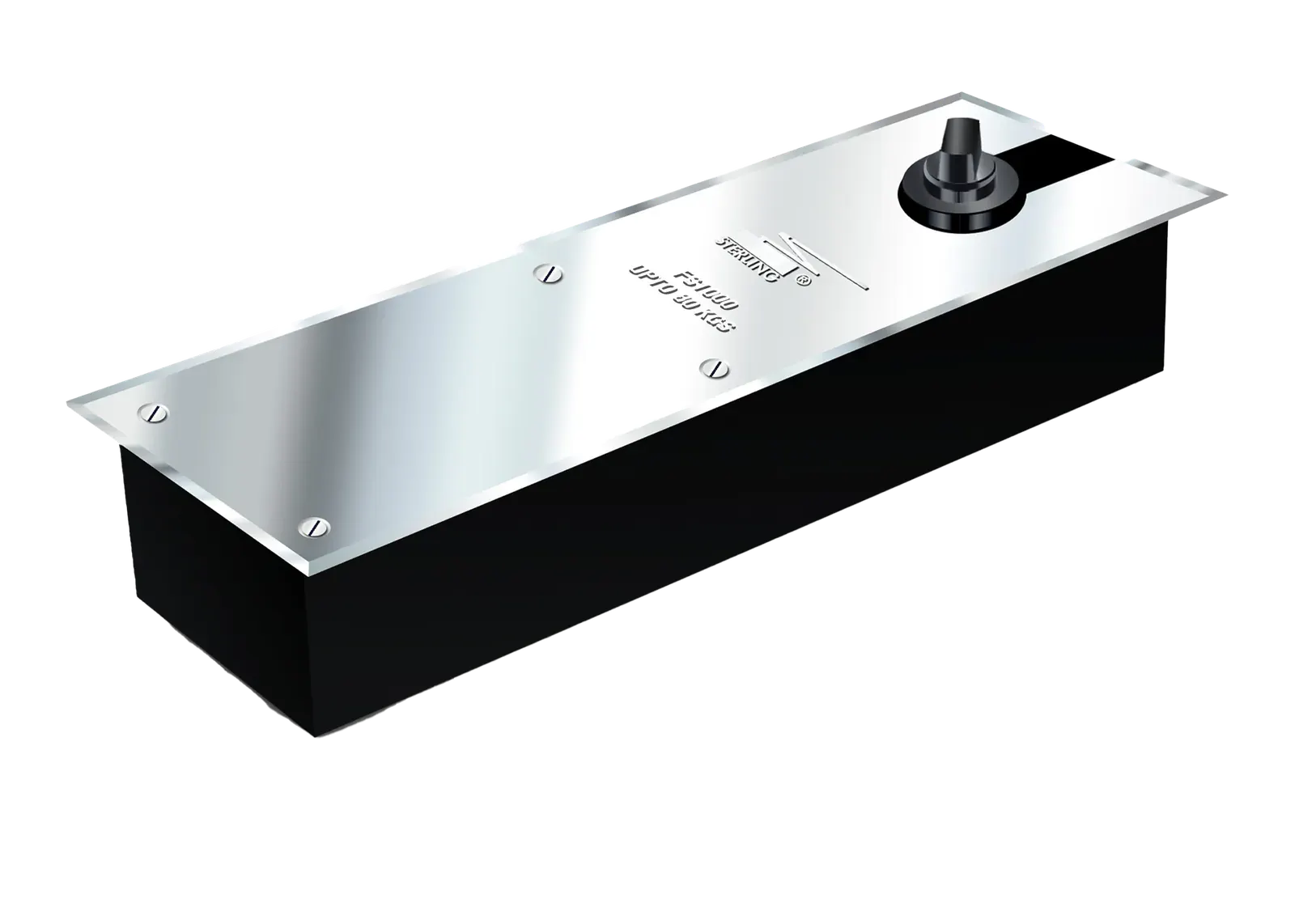
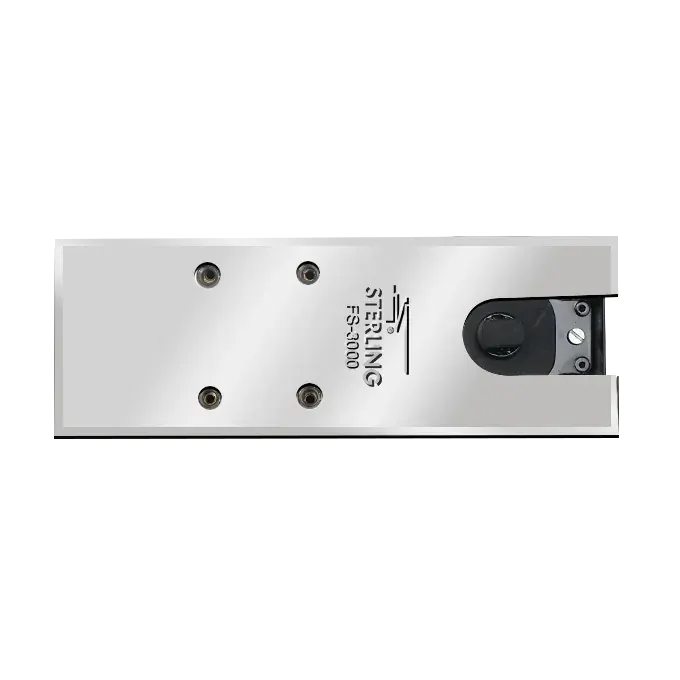
On both models in the Sterling floor spring range, the FS 1000 and the FS 3000, the left-right, front-back and top-bottom adjustments sit inside the box alongside the two speed valves, and the FS 3000 has a load adjustment screw. Screw positions and markings differ by model, so identify each one before turning anything. No floor spring installation guide is published on this site; use the installation sheet if one came with the unit, or ask Sterling customer care or the supplying dealer.
Rule out what is not an adjustment
Three checks come first, because no valve fixes any of them.
- Is the door parked at hold open? Both Sterling floor springs hold open at 90 degrees by design. Check this first on any "floor spring not closing" call.
- Is the door within the rating? The FS 1000 is rated for 60 to 80 kg doors and the FS 3000 for 90 to 120 kg, both up to 1100 mm wide and 2100 mm high. A heavier leaf will not be brought under control by a valve. A leaf lighter than the lower figure is also outside the rating and is likely to be driven closed too hard, so check both ends of the range. See the frameless glass door hardware guide for working out a glass leaf's weight.
- Is anything dragging? A floor finish laid after the door was hung, a threshold strip, a brush seal or grit in the box all take energy out of the swing. Move the door slowly by hand, feel for where it stiffens, and check that the top pivot and bottom fitting are tight.
The two speed valves
Both Sterling floor springs use two-speed control: a closing speed valve for the main sweep and a latching speed valve for the last few degrees, where a double action door has to arrive at centre and stop. They meter oil as on an overhead closer, so the turning direction, eighth-turn steps and the rule never to back a valve fully out are as set out in the door closer adjustment guide.
Reading the valve markings
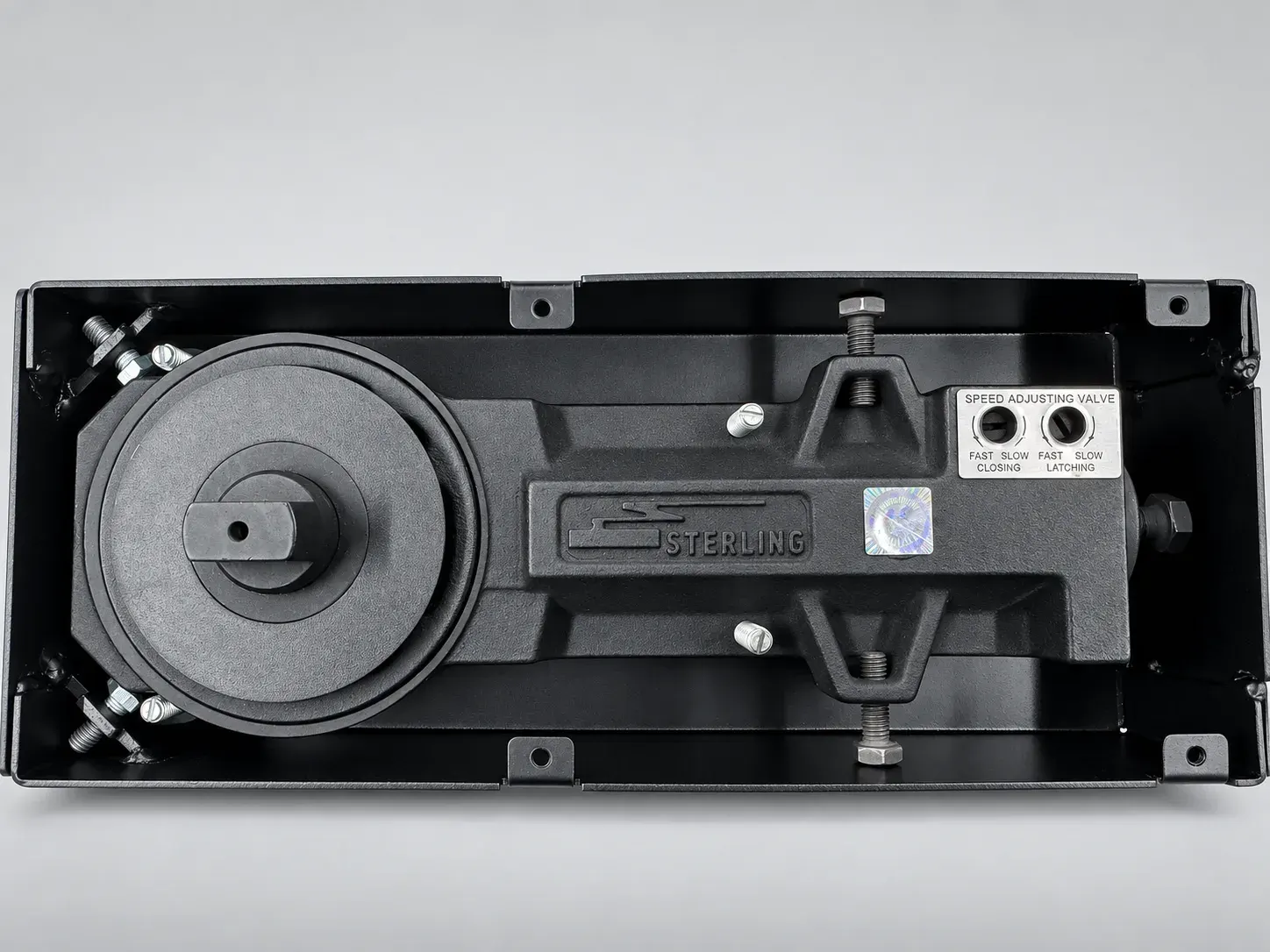
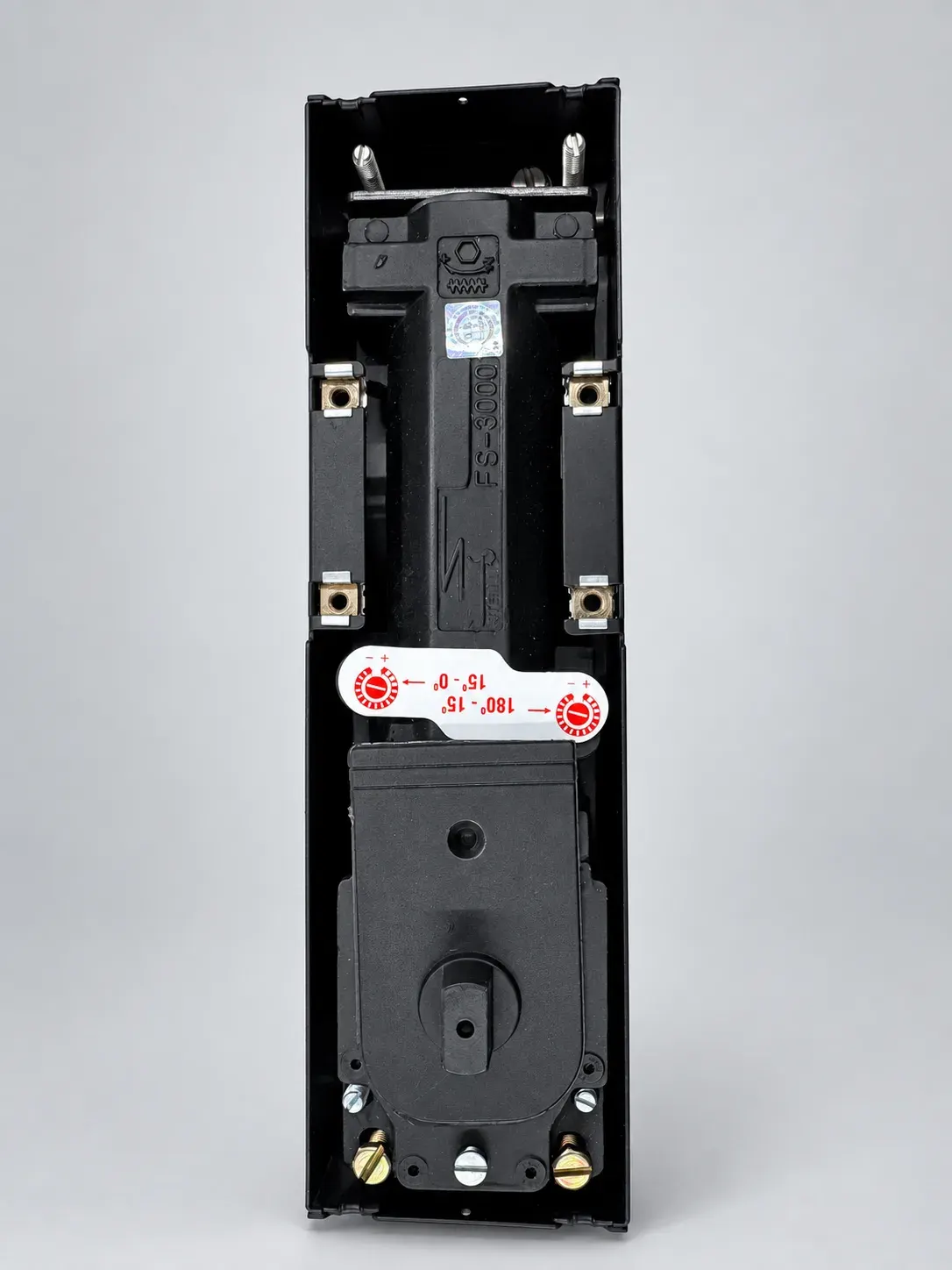
The two models mark their valves differently. On the unit photographed for the FS 1000 page, a plate headed SPEED ADJUSTING VALVE labels one valve CLOSING and the other LATCHING, each marked FAST and SLOW. On the FS 3000 photographed, a sticker gives each valve a minus and plus scale and an arc: 180 to 15 degrees for the main sweep, 15 to 0 degrees for latching. Where a marking is worn, turn one valve an eighth and watch which part of the swing changes; set it back if it was the wrong one.
Setting the speeds from both sides
Both models are listed with double action to prevent door and wall damage. On a door that swings both ways, the same two valves return it to centre from either side, so check everything from both sides.
- Open the door to about 70 degrees, short of the hold open, and release it; taken to 90 degrees it parks and tells you nothing.
- Set the closing valve, then the latching valve. Closed means arriving at centre and staying still.
- Repeat from the other side. A door that behaves from one side only usually has an alignment fault, not a valve fault.
- From each side, push the door to about 15 degrees and let it return. If it stops short of centre, the latching speed is too slow or something drags; if it swings through centre and rocks back, it is too fast.
Hold open at 90 degrees
On both models, swing the door to a right angle and it parks; pull it away and the spring takes over. It needs no setting, but users need telling, because a door "stuck open" at exactly 90 degrees is working as intended.
If the site needs a hold at another angle, or none, ask Sterling before specifying: the product data says nothing about disabling it or changing the angle. Where the door is wooden or aluminium, within 80 kg and 1100 mm, the DC 2600 overhead closer holds from 10 to 90 degrees.
Alignment: left-right, front-back and top-bottom
A door on a floor spring has to hang plumb, with the spindle and the top pivot on one vertical line. When they are not, the door binds in the swing, the leading edge gap runs out of parallel, or the door will not settle at centre.
Each of the three adjustments inside the box moves the spindle, and with it the bottom of the door, on one axis:
| Adjustment | What it moves | Use it when |
|---|---|---|
| Left-right | The spindle along the line of the frame | The gap at the leading edge is wider at the bottom than the top, or the pivot-side edge rubs |
| Front-back | The spindle in or out of the plane of the door | The door sits proud of or behind the frame when closed, or will not find centre |
| Top-bottom | The height of the door | The bottom edge drags, or the top pivot is not fully engaged |
Work one axis at a time: loosen only the fixing for that axis, move the spindle a small amount, retighten, and swing the door both ways before touching the next. After any change in height, check the top pivot again. Which screw serves which axis, its travel, the tool needed and whether the door must come off the spindle are not in the product data; take them from the installation sheet, if one came with the unit, or from Sterling customer care. If an axis runs out of travel first, the cement box or top pivot is probably out of position: a setting-out fault, not a hardware one.
Load adjustment on the FS 3000
The FS 3000 has a load adjustment screw that matches the spring to the door across its 90 to 120 kg range. Use it when the valves are right but the door still arrives with too little energy, or closes harder than needed. Weigh or calculate the door first, adjust in small steps, and repeat the 15 degree test. The screw direction is not in the product data; take it from the installation sheet, if one came with the unit, or from Sterling customer care.
The FS 1000 is rated for 60 to 80 kg doors; choose it against the door's weight.
When the unit needs replacing
Oil in the box or around the top plate means a seal has failed. The unit cannot be topped up on site, and without oil the door swings free, a safety problem on a heavy glass leaf. Replace it. If the same door keeps needing its valves moved, something is changing: a fixing working loose, a patch fitting creeping, or a unit on its way out. Both Sterling floor springs are tested for 5,00,000 cycles in a government-approved lab. A unit that will not hold its setting should be reported to the supplying dealer or Sterling customer care.
Questions
Why is my floor spring door not closing?
Check, in order: the 90 degree hold open, anything dragging along the bottom edge or inside the box, a latching speed throttled too far, and a door heavier than the unit's rating.
Which way do you turn a floor spring speed valve?
On hydraulic closers generally, clockwise slows that part of the swing and anticlockwise speeds it up. Follow the valve marking where there is one, confirm with an eighth of a turn, and never unscrew a valve fully. The direction of the FS 3000 load adjustment screw and the alignment screws comes from the installation sheet, if one came with the unit, or from Sterling customer care.
Can a floor spring be adjusted without taking the door off?
On the FS 1000 and FS 3000 the valves and alignment adjustments are inside the box, so the unit stays in the floor. Whether the door must come off the spindle depends on the fitting; check the installation sheet, if one came with the unit, or ask Sterling customer care.
How do I tell the closing valve from the latching valve?
On the FS 1000 photographed, a plate labels them CLOSING and LATCHING. On the FS 3000, the 180 to 15 degree valve is the closing sweep and the 15 to 0 degree valve is latching.