
CHOOSING & SIZING
How to measure a door before choosing a closer
Most wrong closers are ordered off a guess at the door. Five measurements remove the guesswork, and none of them need special tools.
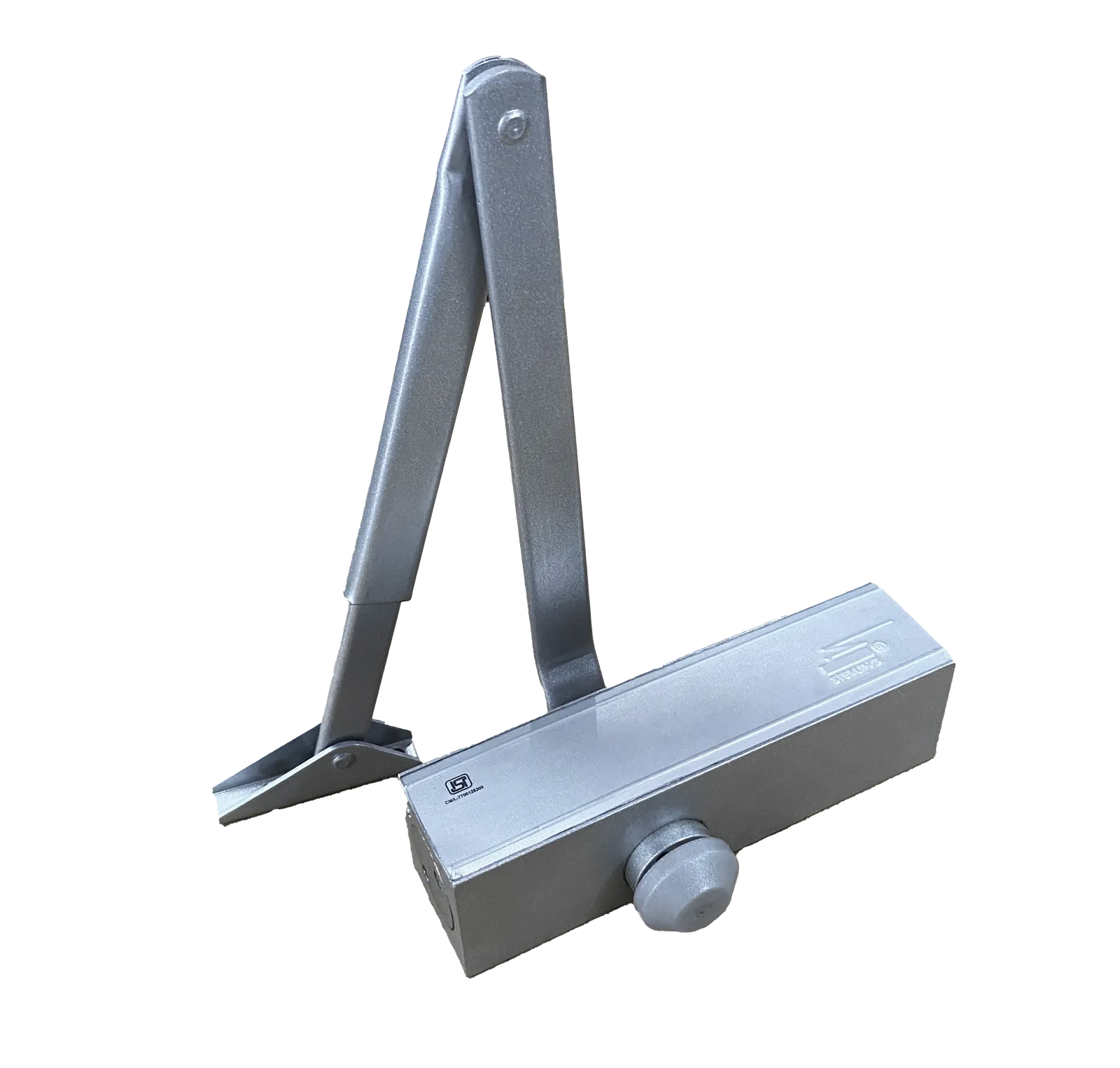
A door closer that arrives and does not suit the door is nearly always a measuring problem rather than a product problem. Five figures settle almost every specification, and all of them can be taken with a tape measure and a few minutes at the door.
1. Leaf width
Measure the door leaf itself, from the hinge edge to the leading edge, not the frame or the structural opening. This is the figure that drives EN power size, because leaf width sets the leverage the closer works against. A door only 50 mm wider than you assumed can push the requirement up a whole power size.
Measure the leaf while it is closed, across the face, and record it in millimetres.
2. Leaf mass
Weight is the second half of the power size calculation, and the one people estimate badly. A hollow-core internal door, a solid-core door and a framed glass door of identical dimensions can differ by a factor of three.
If the door is not yet hung, weigh it. If it is already in service, use the manufacturer's leaf data rather than a guess. Door schedules usually carry it. Where nothing is available, the construction is the best guide: hollow-core flush doors are light, solid-core and laminated leaves are substantially heavier, and anything with glass or a steel core heavier still.
3. Leaf thickness
Thickness only matters for concealed closers, but for those it is decisive: the body has to fit inside the leaf. The DC 2800, for example, suits wooden doors from 38 mm thickness upwards. A thin or hollow leaf rules concealed out entirely and sends you to a surface-mounted model.
4. Handing
Stand on the outside of the door, the side it opens away from, and note which side the hinges are on. That is the door's hand, and it determines how the closer and its arm are set out.
It matters less than it used to, because many closers are reversible: across the Sterling range the surface-mounted models use universal mounting for both left and right hand doors, so one unit covers either. It is still worth recording, because it governs which face the body goes on and which way the arm reaches.
5. The space above the door
This is the measurement most often skipped, and the one that causes returns. A surface-mounted closer needs a clear flat area on the leaf or frame for the body, plus room for the arm to swing without fouling anything.
Check three things: the height of the frame head or soffit above the door, whether there is a transom light, architrave or panel where the body would sit, and whether anything projects into the arm's path once the door is open: a wall return, a cill, a bulkhead. Where the space above the door is tight, the compact models matter: the DC 1820 body is L162 x W40 x H45 mm against the L254 x W105 x H54 mm of the DC 1800 LA, for the same 60 kg door rating.
Two things worth noting alongside
Record whether the door is internal or external. External doors fight wind and stack pressure and frequently need a power size above what the dimensions alone suggest.
And note what the door has to close against: a latch with a stiff spring, a smoke seal, a draught seal or a carpet threshold all add resistance at the end of the swing, which is exactly where the closer has least leverage.
Putting it together
With width and mass you can read a power size straight off the EN scale. Thickness tells you whether concealed is even possible. Handing and the space above the door tell you which body and arm arrangement will physically fit. If a door sits on a boundary between two power sizes, specify the model whose adjustable range reaches the higher one. You can always turn the force down, and you cannot turn it up past the model's limit.