
CHOOSING & SIZING
What size door closer do I need? EN power sizes explained
Every door closer is sized against two numbers: how wide the door leaf is and how much it weighs. The EN power size scale puts both on one axis.
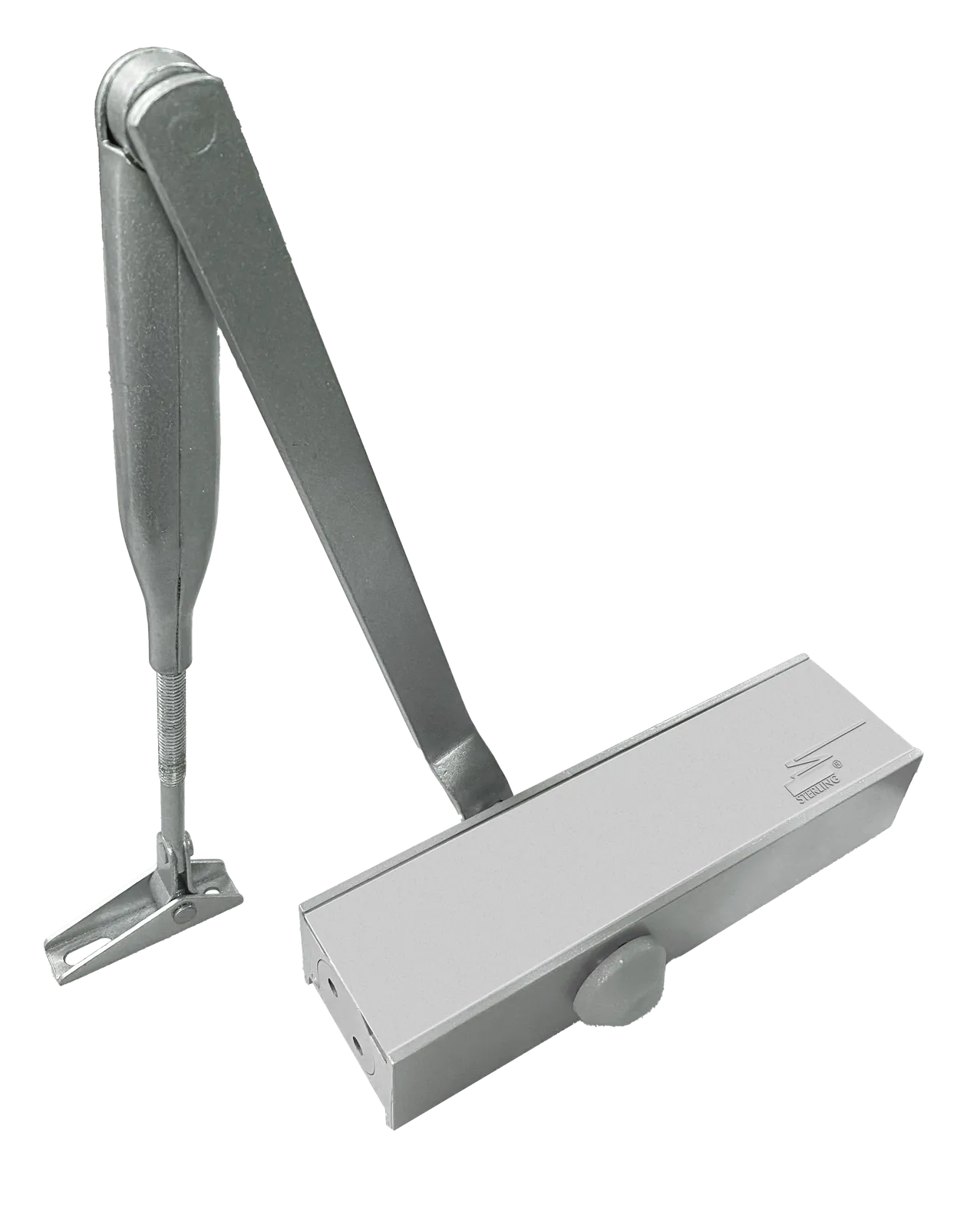
Picking a door closer is mostly an exercise in sizing. Get it right and the door closes under control, latches properly and stays that way for years. Get it wrong and you get one of two failures: a closer too weak to pull the door shut against a latch or a draught, or one so strong that people struggle to open the door at all. Both are common, and both come from reading only half the specification.
The EN power size scale
Controlled door closing devices are classified by power size under EN 1154, the European standard for them, on a scale from 1 to 7. The size is not an arbitrary strength rating. Each step is tied to a maximum door leaf width and a maximum door mass:
| EN power size | Max door leaf width | Max door mass |
|---|---|---|
| EN 1 | 750 mm | 20 kg |
| EN 2 | 850 mm | 40 kg |
| EN 3 | 950 mm | 60 kg |
| EN 4 | 1100 mm | 80 kg |
| EN 5 | 1250 mm | 100 kg |
| EN 6 | 1400 mm | 120 kg |
| EN 7 | 1600 mm | 160 kg |
Width and mass are both limits, not an average
This is where most sizing errors happen. The two figures are ceilings, and the door has to sit under both of them. A 1050 mm wide door that weighs only 45 kg is not an EN 3 job because of its weight. The width alone pushes it to EN 4. Leaf width matters because it sets the leverage the closer has to work against: the further the handle sits from the hinge, the more torque is needed to move the door through its last few degrees.
Read the wider of the two requirements and size to that. If a door sits right on a boundary, size up rather than down. An oversized closer can usually be brought back within a comfortable opening force using the adjustment on the arm; an undersized one has nothing left to give.
Why closers are sold in ranges
You will notice most closers are quoted as a range rather than a single size: EN 2-3, EN 3-4, EN 4-5. That reflects an adjustable spring: the closing force can be set anywhere within that band, usually by repositioning or preloading the lever arm. It is what lets one model cover a spread of doors, and it is why a single closer can suit both a 60 kg internal door and an 80 kg one.
Across the Sterling range the bands line up like this. The DC 1500 covers EN 1-2 for doors up to 45 kg and 900 mm. The DC 1800 LA and DC 1820 cover EN 2-3, up to 60 kg and 950 mm. The DC 2000 and DC 2600 cover EN 3-4, up to 80 kg and 1100 mm. The DC 2900 covers EN 4-5, up to 100 kg and 1100 mm.
What else changes the answer
Three things commonly push a door up a size beyond what its dimensions suggest. Wind and stack pressure is the big one: an external entrance, or any door on a corridor that behaves like a wind tunnel, needs more closing force to latch reliably than the same door inside a building. A latch with a strong spring, or a seal that the door has to compress, adds resistance at exactly the point where the closer has least leverage. And doors on a slight rising butt or out-of-plumb frame lose energy to friction all the way through the swing.
Pulling the other way is accessibility. A closer set harder than it needs to be makes a door difficult for children, elderly users and wheelchair users to open, so the goal is the lowest setting that still closes and latches the door reliably every time, not the highest setting the model allows.
Measure first
Before specifying anything, take two measurements: the leaf width from the hinge edge to the leading edge, and the mass of the leaf. Width is straightforward. Mass is often estimated from the leaf construction: a hollow-core internal door, a solid-core door, a framed glass door and a fire-rated leaf of the same size differ substantially. If the door is already hung and you cannot weigh it, the manufacturer's leaf data is a better source than a guess.