
CHOOSING & SIZING
Floor spring or door closer? How to choose between them
Both control how a door closes, but they solve different problems. The deciding factors are usually the door material, the weight and whether anything can be seen.
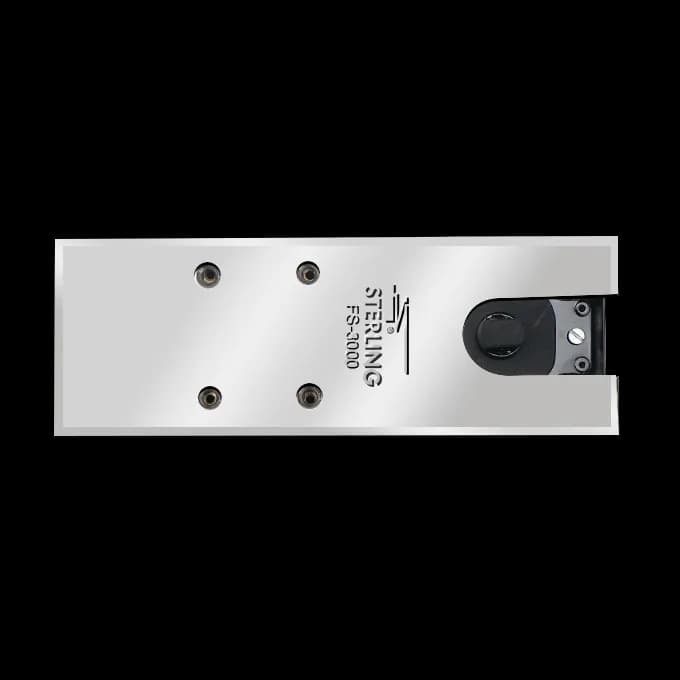
A floor spring and an overhead door closer do the same job, returning a door to the closed position under control, but they are built around different constraints, and the choice between them is usually settled by the door itself rather than by preference.
Where each one sits
An overhead door closer mounts on the face of the door leaf or on the frame above it, and drives a lever arm that reaches across to the other surface. The mechanism is above head height and visible unless the model is a concealed type fitted into the leaf or transom.
A floor spring is set into the floor beneath the door, in a cement box, with only a cover plate showing. The door pivots on a spindle that comes up out of the unit, so the floor spring carries the weight of the door as well as controlling its swing. Nothing is visible on the door itself.
The door material usually decides it
For frameless glass doors, a floor spring is effectively the default. There is no frame to mount an overhead closer to and no leaf to screw into, so the door has to be supported and driven from its pivot points, with patch fittings clamping the glass top and bottom. This is why floor springs are what you find under the doors of showrooms, bank branches and shopfronts.
For timber and aluminium doors, either will work, and the decision moves to weight, appearance and what the floor allows. Overhead closers are far simpler to retrofit. They fix to surfaces that already exist. A floor spring needs a recess formed in the floor slab, which is straightforward during construction and disruptive afterwards.
Weight and double action
Because a floor spring carries the door on a spindle rather than hanging it from hinges, it handles heavy leaves comfortably. The Sterling FS 1000 is rated for doors of 60 to 80 kg and the FS 3000 for 90 to 120 kg, both up to 1100 mm wide, with a load adjustment screw to match the spring to the actual door.
Floor springs also allow double-action swing, where the door opens in both directions and returns to centre. An ordinary overhead closer on butt hinges cannot do that. For an entrance where traffic runs both ways, that matters.
Hold open and back check
Both Sterling floor springs have a built-in hold open at 90 degrees, which parks the door open at a right angle for deliveries or ventilation, and a back check that resists the door being flung open hard enough to damage the leaf or the wall behind it. On an overhead closer, hold open is a model-specific feature rather than a given: among the Sterling closers, the concealed DC 2800 has an inbuilt hold open that holds anywhere from 10 to 90 degrees.
Maintenance and access
This is the practical trade-off people underestimate. An overhead closer is accessible with a ladder and a screwdriver. Speed valves can be adjusted in a minute and the whole unit can be swapped without touching the building. A floor spring is under the door, in the floor, and adjusting or replacing it means lifting the door off its spindle. Both Sterling floor springs put the left-right, front-back and top-bottom adjustments inside the box so alignment can be corrected without removing the unit, but the access is still floor-level work.
A short way to decide
If the door is frameless glass, needs to swing both ways, or the design calls for nothing visible above the door, specify a floor spring and plan the floor recess early. If the door is timber or aluminium, is being retrofitted, or sits in a building where maintenance access matters more than appearance, an overhead closer is the simpler and cheaper answer.