
CHOOSING & SIZING
Surface-mounted vs concealed door closers
The mechanism is much the same. What changes is where it lives, and that affects installation, servicing and what the finished door looks like.
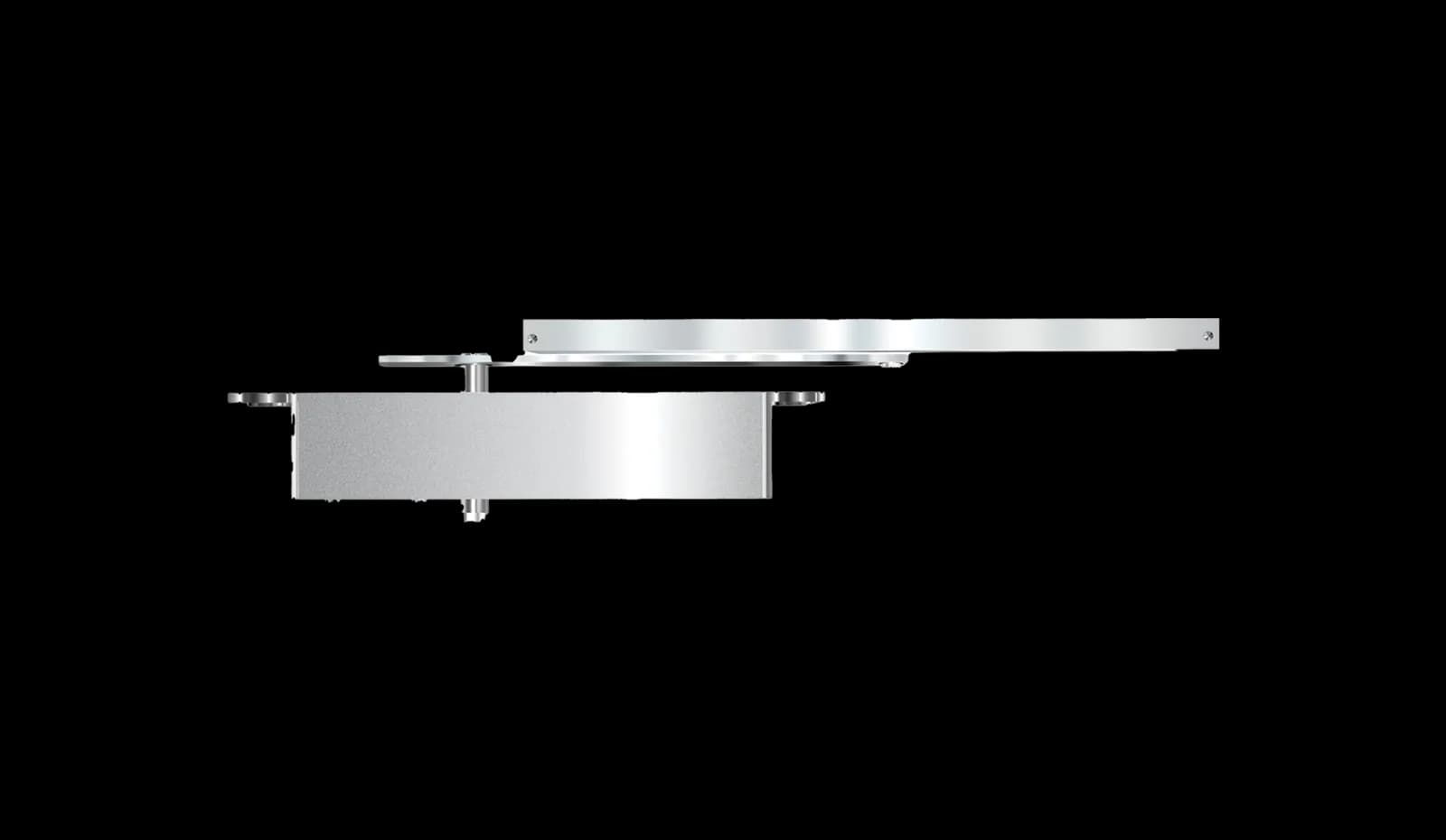
Overhead door closers come in two mounting families, and the difference is entirely about where the body sits. Both use the same underlying rack-and-pinion mechanism driving against a spring, with hydraulic valves metering the return.
Surface-mounted
A surface-mounted closer bolts onto the face of the door leaf or onto the frame, with a lever arm bridging to the opposite surface. Everything is on the outside of the door.
The advantages are practical. Installation needs only a drill and the template that comes with the unit, so a closer can be fitted to a door that is already hung and in service. Adjustment valves are on the body, within reach of a ladder. If the unit fails, it comes off and a replacement goes on in the same holes. Because the mechanism is not constrained by the thickness of the leaf, surface closers also cover the higher power sizes comfortably. The Sterling range runs from the DC 1500 at EN 1-2 up to the DC 2900 at EN 4-5 for doors up to 100 kg.
The disadvantage is that you can see it. On a plain office or service door nobody minds. On a feature entrance it is a visible box and an arm above the door.
Concealed
A concealed closer is morticed into the door leaf or into the transom above it, so that when the door is shut nothing shows but a slim cover plate and the arm channel. The Sterling DC 2700 and DC 2800 are concealed types.
The appeal is obvious: a clean door line, which is why concealed closers get specified on hotel rooms, boardrooms, apartments and anywhere the door is part of the interior design rather than just a barrier.
The costs are less obvious. The leaf has to be thick enough and solid enough to take the pocket. The DC 2800 suits doors from 38 mm thickness upwards, which rules out thin or hollow-core leaves. The mortice has to be cut accurately, which is workshop work, so concealed closers are far easier to specify at construction than to retrofit. Their slim bodies also constrain the spring, so the power sizes available tend to be lower than the surface equivalents: the DC 2700 covers EN 2-3 up to 60 kg, and the DC 2800 adjusts across EN 2-4 by preloading the arm.
Servicing is the real difference
Over a building's life this matters more than the initial fit. A surface closer that starts slamming is adjusted in a couple of minutes from a stepladder. Reaching the valves on a concealed unit may mean removing a cover plate or, on some installations, taking the door down. Replacing a failed concealed closer means opening up the mortice again.
Where a building has a maintenance team and a lot of doors, surface closers keep the recurring work cheap. Where appearance governs and the doors are few, concealed units earn their extra installation cost.
Choosing between them
Ask three questions in order. Is the door being retrofitted, or is this new work with the leaves still in the shop? Is the leaf thick and solid enough to take a mortice? And does the door need a power size that a concealed body can actually deliver? If the answer to any of those points away from concealed, a surface closer is the right specification, and on the great majority of commercial doors it is.