
APPLICATIONS BY BUILDING TYPE
Specifying door closers for high-traffic entrances
On a busy entrance, durability and opening force stop being footnotes and become the specification.
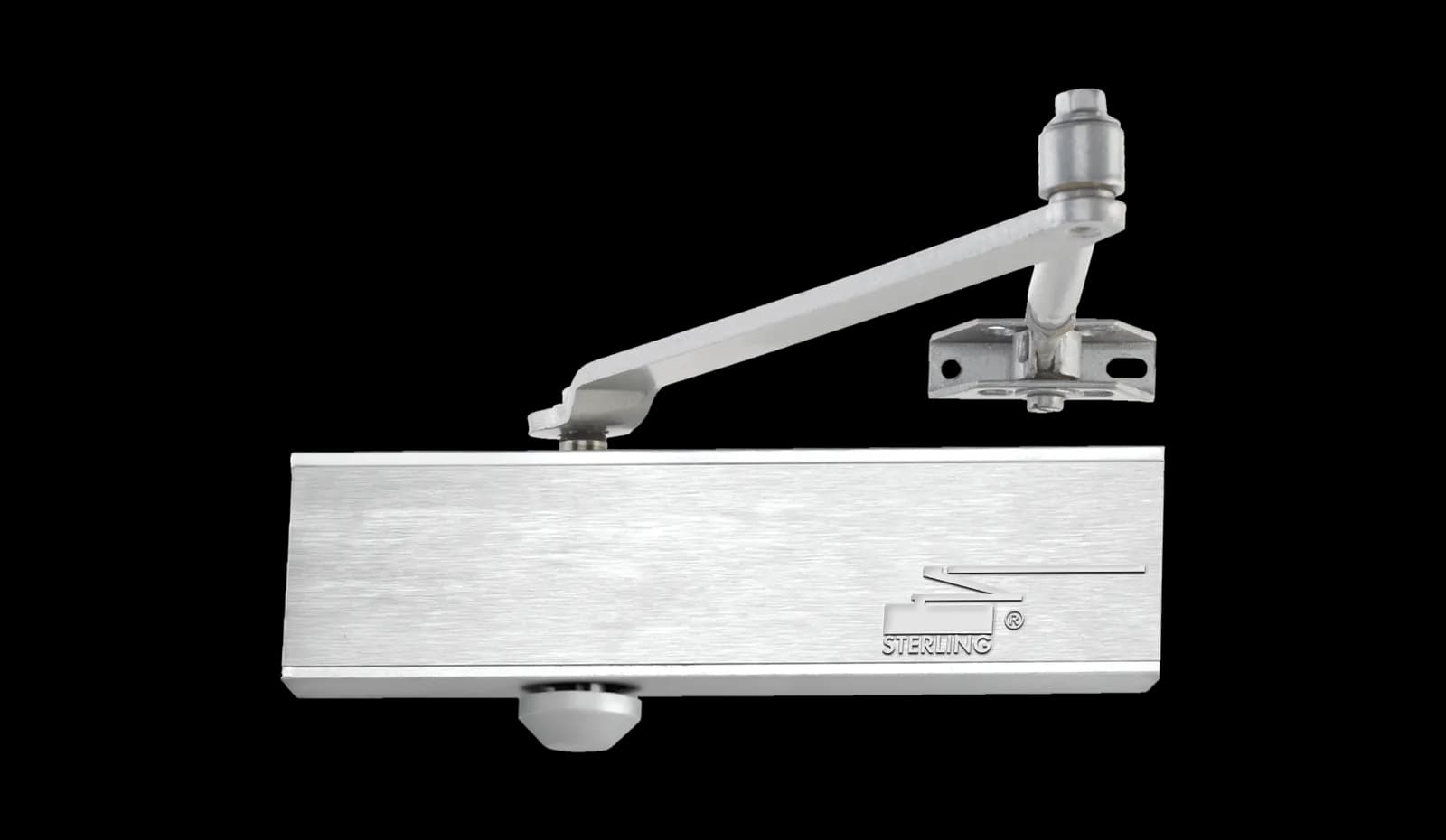
Sizing a closer for a quiet internal office door is mostly arithmetic: measure the leaf, read the EN power size, fit it. On an entrance that cycles several hundred times a day the same arithmetic gives you a closer that is technically correct and still the wrong specification.
Durability becomes the governing number
The industry durability benchmark is 500,000 cycles, or five lakh, which is the figure Sterling's door closers and floor springs are tested to, and the durability requirement in EN 1154.
Do the division for the building in question. A door cycling 200 times a day reaches 500,000 cycles in roughly seven years. The same door at 500 cycles a day gets there in under three. On an internal door cycling a few dozen times a day the figure is effectively irrelevant; on a main entrance it sets a replacement interval you should be planning for rather than discovering.
Opening force is a user problem at scale
A door set slightly harder than necessary is a minor irritation once and a significant barrier when it is the entrance every visitor uses, including people carrying things, pushing trolleys or using wheelchairs. Public buildings are exactly where this is felt most.
The specification response is to size the closer properly rather than to compensate with force: get the power size right for the leaf width and mass, then set the arm to the lowest force that still latches the door reliably every time. Where an entrance is exposed and genuinely needs more force to overcome wind pressure, that is a case for looking at the door's shelter and seals as well as at the closer.
Size up for external doors
Entrance doors are usually the ones fighting wind and stack pressure, and both act hardest at the end of the swing where the closer has least leverage. A leaf whose dimensions put it at the top of an EN 3 band is often better served by a closer whose range reaches EN 4, so there is adjustment left in hand. The Sterling DC 2000 and DC 2600 cover EN 3-4 for doors to 80 kg and 1100 mm; the DC 2900 covers EN 4-5 to 100 kg.
Glass entrances
Retail and hospitality entrances are frequently frameless glass, which takes the decision out of the overhead closer family altogether: there is no frame to fix to. These run on floor springs, which carry the door on a spindle and allow double-action swing so traffic can move both ways. The FS 1000 handles 60 to 80 kg leaves and the FS 3000 90 to 120 kg, both with a load adjustment screw so the spring can be matched to the actual door.
Both include a back check, which resists the door being thrown open hard enough to damage the leaf or the wall behind it, worth having anywhere a door gets pushed rather than opened, which is most busy entrances.
Hold open, and where it does not belong
Hold open is useful on doors that genuinely need to stay open: a service entrance during deliveries, a room being ventilated. Both Sterling floor springs have a built-in hold open at 90 degrees, and among the overhead range the concealed DC 2800 holds anywhere from 10 to 90 degrees.
It is worth being deliberate about it. A door held open is a door not doing its job, and on any door with a fire or smoke separation function, hold-open arrangements are governed by fire regulations rather than by convenience. That is a question for the project's fire consultant, not a hardware preference.
Plan for maintenance access
On a building with a lot of doors, the recurring cost is adjustment and replacement rather than the initial hardware. Surface-mounted closers are adjusted from a stepladder in minutes and swapped without touching the building fabric. Concealed units and floor springs both look better and cost more to reach. On a high-traffic entrance that will be serviced repeatedly over its life, that trade-off deserves a decision rather than a default.