Door closers for aluminium doors: what to check first
Covers EN 1-2 to EN 4-5
An aluminium door gives a closer less to fix to than a timber one. Check the section width, the fixing, the leaf mass and the mounting position before a model is chosen.
- Written by
- Sterling
- Published
- Updated
A timber leaf takes a screw almost anywhere. An aluminium leaf is a frame of hollow extruded sections around glass or a panel, so a closer can fix only to the narrow top rail and the frame head above it, a screw in a single thin wall is held by very little metal, and most of the weight is in the glass.
None of this changes how a closer is sized: the EN power size still comes from leaf width and mass, as the guide on what size door closer you need explains. It changes whether the closer can be fitted, and how. Five checks cover it.
1. Measure the sections the closer will fix to
Measure the face width of the top rail of the leaf, from the glazing bead to the outer edge, and the face width of the frame head above it. If the door sits under a glazed transom, the frame head is the transom bar. Record both in millimetres.
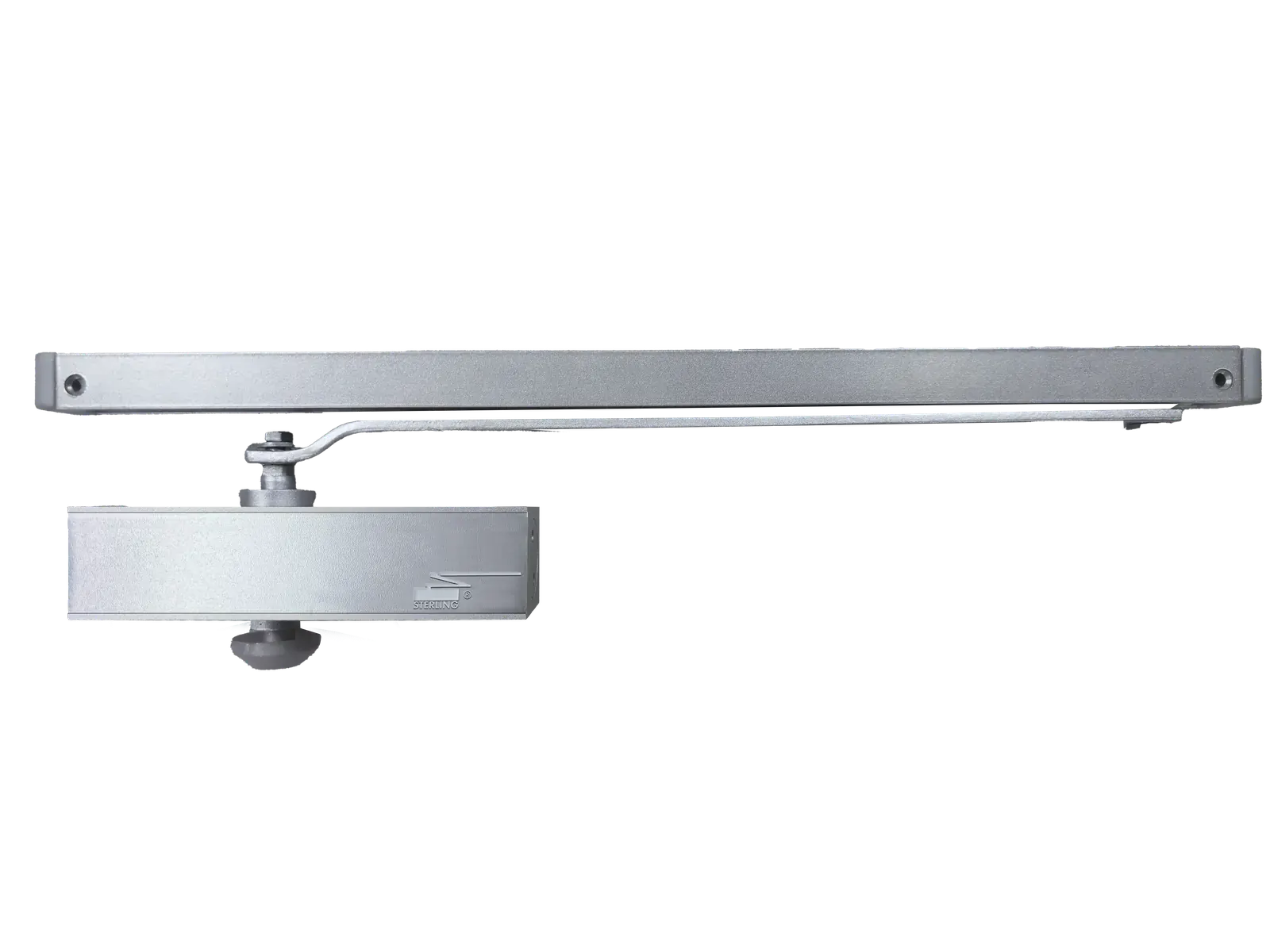
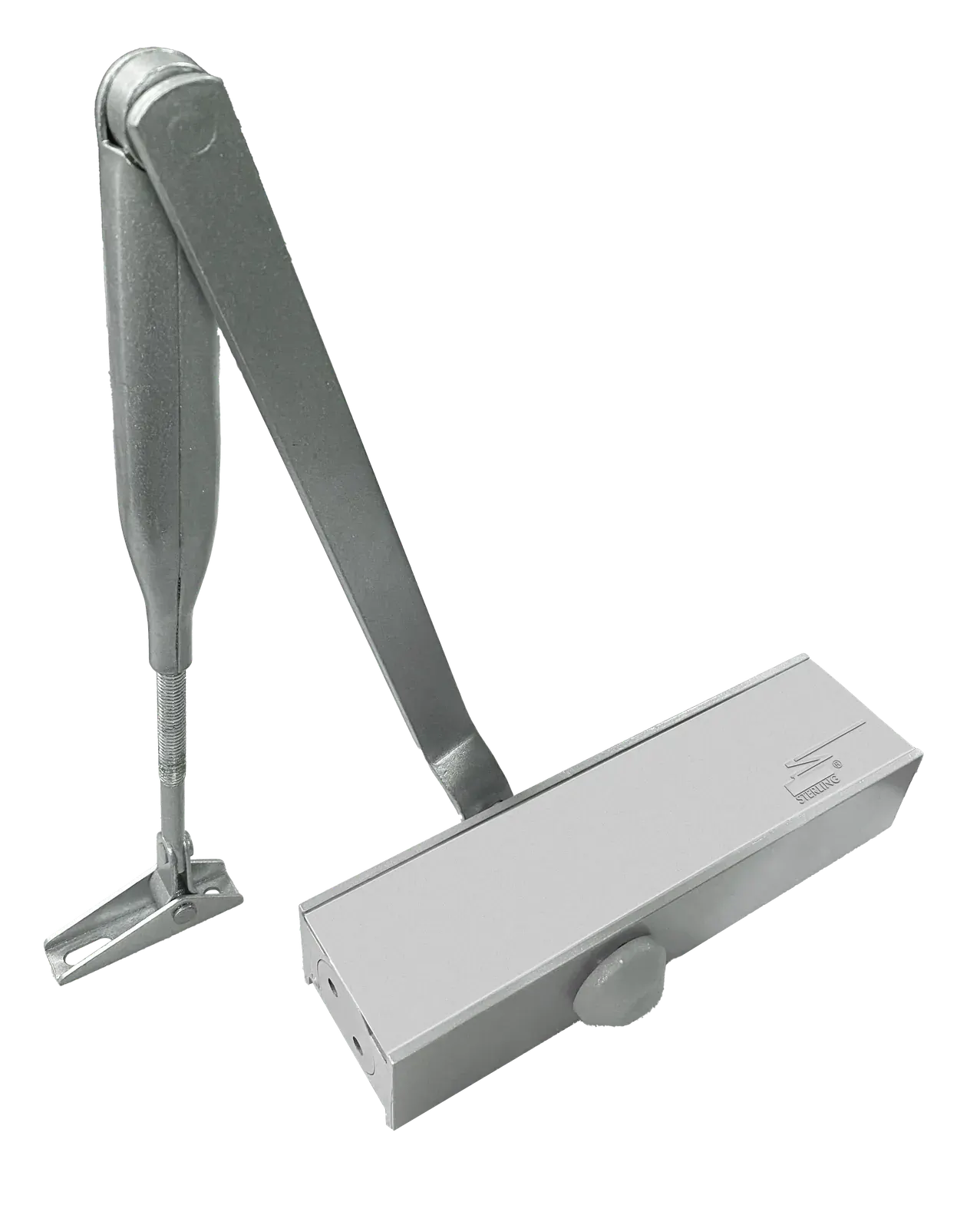
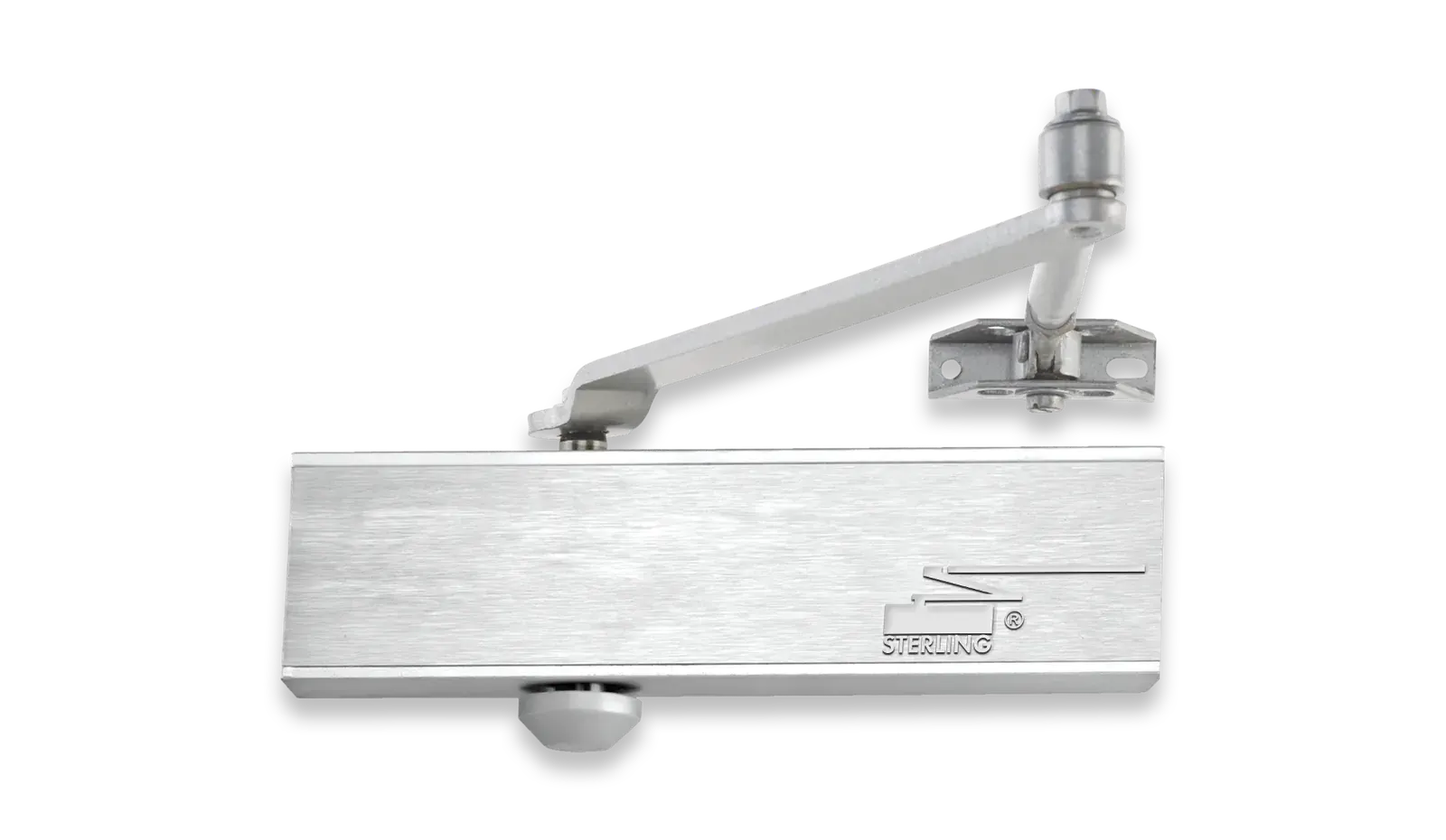
The closer body has to sit on the section, and every fixing hole has to land in metal rather than in the glazing bead, the gasket line or the gap between two sections. Three Sterling surface-mounted models, from light to heavy:
Scroll the table sideways for every column.
| Model | Body (L x W x H) | Door weight | Door width | Closing force |
|---|---|---|---|---|
| DC 1500 | 190 x 39 x 40 mm | Up to 45 kg | Up to 900 mm | EN 1-2 |
| DC 1820 | 162 x 40 x 45 mm | Up to 60 kg | Up to 950 mm | EN 2-3 |
| DC 2000 | 202 x 40 x 55 mm | Up to 80 kg | Up to 1100 mm | EN 3-4 |
The sizes are as printed and do not say which face of the body sits on the rail. The DC 1500 description lists a reduced mounting hole distance for the limited space of an aluminium section, and a slim, compact body. Before ordering the DC 1500, DC 1820 or DC 2000, ask Sterling for the installation guide, or for the hole centres and body height.
2. Decide where the body goes: on the door or on the frame
A surface closer mounts two ways: on-door, with the body on the leaf top rail and the arm reaching to a bracket on the frame head, or on-frame, with the body on the frame head and the arm reaching down to the leaf. The DC 1500, DC 1820 and DC 2000 are all listed as suitable for on-door and on-frame installation, as are the DC 1800 LA and the DC 2900, so the choice is made on geometry.
If the leaf top rail is too narrow for the body but the frame head or transom bar is deeper, go on-frame. If the frame head is a slim section and the leaf rail is the heavier member, go on-door. Whichever surface takes the body, the other takes the arm bracket, so both need checking.
Handing does not change the model, since the surface-mounted range uses universal mounting for left and right hand doors. Arm type does, since each arm has its own bracket position: the DC 1500 comes with a lever, pelmet or hold-open pelmet arm, the DC 1820 with a hold-open pelmet arm and the DC 2000 with a lever arm.
3. Fix into metal that can hold
This is general practice for hollow metal doors rather than a Sterling instruction. A screw into a single thin wall of an extrusion works loose under the repeated pull of a closer, and an opened-out hole leaves nothing to re-fix into. The usual answers are a backing plate on the far side of the section with through-bolts, threaded inserts set into the section, or a reinforcing strip the fabricator builds into the top rail.
Ask the fabricator whether the top rail is reinforced where a closer will fix, and what fixing the system supplier recommends. If nobody knows, a backing plate is the safe default. The guide on door closer installation mistakes covers the same problem on hollow-core timber doors.
4. Work out the leaf mass, do not guess it
Each millimetre of glass thickness adds about 2.5 kg to every square metre of glazing, so 6 mm glass comes to about 15 kg a square metre. Multiply the glazed area by the glass thickness and by 2.5, then add the sections and hardware from the system supplier's weight tables.
With a mass and a width, read the closer off its limits. Both are ceilings and the door has to sit under both:
- Up to 45 kg and 900 mm wide: DC 1500, EN 1-2. Its printed limits run past the EN 2 band in EN 1154 (40 kg, 850 mm), so where EN sizing is specified, a leaf above 40 kg or 850 mm takes an EN 3 model such as the DC 1820 or DC 1800 LA, or ask Sterling.
- Up to 60 kg and 950 mm wide: DC 1820 with a hold-open pelmet arm, or DC 1800 LA with a lever arm, both EN 2-3.
- Up to 80 kg, 1100 mm wide and 2100 mm high: DC 2000, EN 3-4. The DC 2600 covers the same door with a pelmet arm and a hold-open from 10 to 90 degrees.
- Up to 100 kg and 1100 mm wide: DC 2900, EN 4-5, which Sterling lists as designed to withstand heavy wind pressure.
An external door that faces wind needs a closer sized above what its dimensions alone suggest. Of these closers, only the DC 2000 and DC 2600 print a door height, up to 2100 mm; for a taller leaf, ask before specifying.
5. Hold-open, speed adjustment and marks
Hold-open is a model choice rather than a field setting, so decide it before ordering. The DC 1820 is the hold-open pelmet arm model for doors up to 60 kg; its page prints no degree range, so ask before relying on an angle. The DC 1500 is available as the DC-1520 HPA variant, and for doors up to 80 kg the DC 2600 holds from 10 to 90 degrees. On a door with a fire or smoke separation role, hold-open is a matter for the project's fire consultant.
The DC 1820 and DC 2000 have front control speed adjustment, so closing and latching speeds are set from the face of the closer; the DC 1800 LA is also available with it.
The DC 1500, DC 1800 LA, DC 1820, DC 2000, DC 2600 and DC 2900, like every Sterling door closer, are ISI marked to IS 3564:1995 under BIS licence CM/L 7700126309. CE marking is per model: the DC 1800 LA, DC 1820, DC 2000, DC 2600 and DC 2900 are CE marked. The DC 1820 is tested to 4,00,000 cycles and the DC 2000 to 5,00,000 cycles in a government-approved lab; no cycle figure is printed for the DC 1500.
When the aluminium door is not a closer job
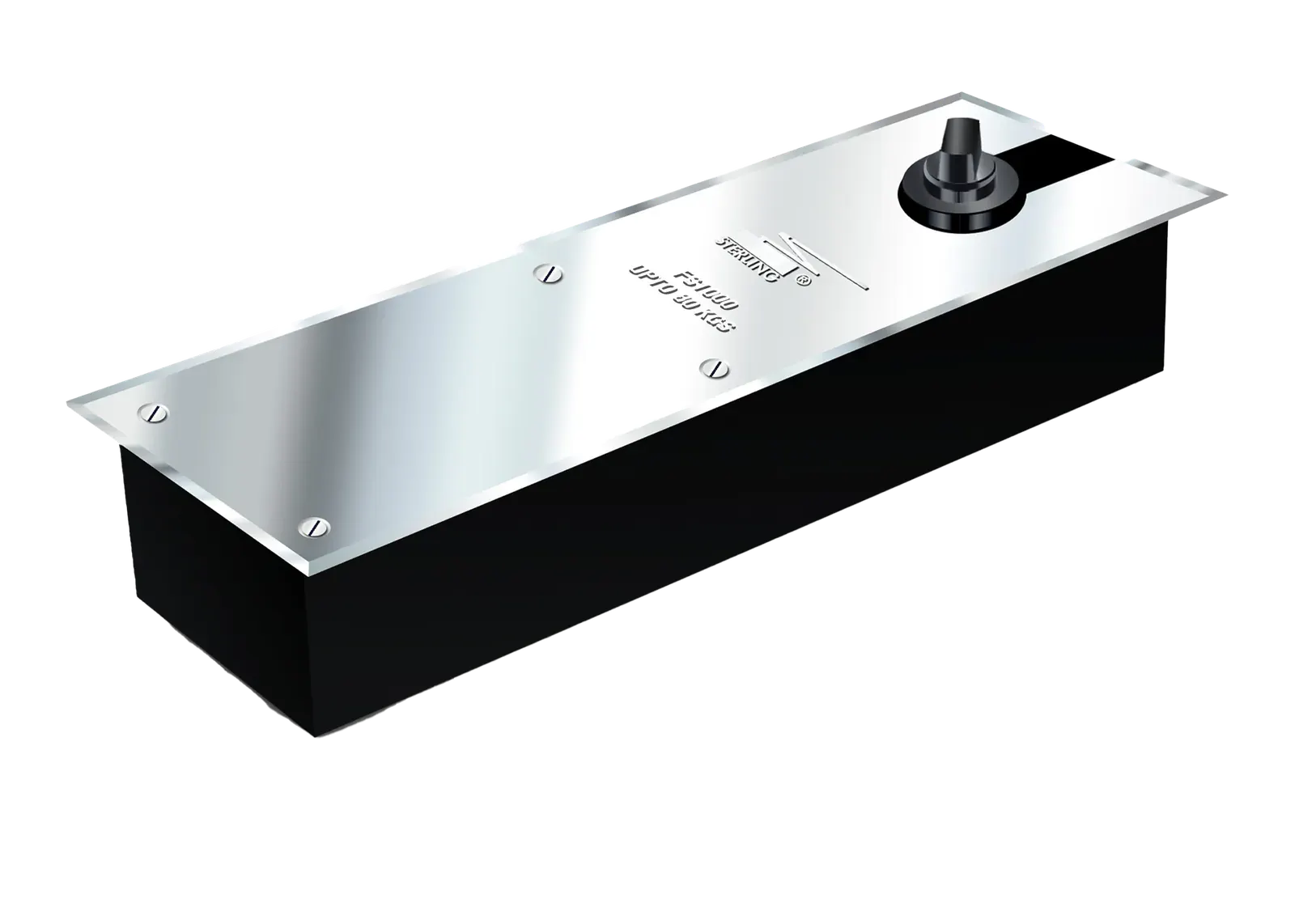
A frameless glass door has no aluminium frame to fix to, so it runs on a floor spring; the guide on hardware for frameless glass doors covers that. A door that has to swing both ways is a floor spring job too; floor spring or door closer sets out the trade-offs. The Sterling floor springs are on the floor springs page.
What to send with an enquiry
For each door type: leaf width and height, leaf mass or glass thickness and glazed area, face width of the leaf top rail and the frame head, internal or external, on-door or on-frame, hold-open or not, and the quantity. Preparing a door schedule for a quote gives the format. Send it through the quote form, or compare the models on the door closers page.
Questions
Which Sterling door closer is made for aluminium doors?
All the Sterling surface-mounted closers are listed for wooden and aluminium doors. The DC 1500 is the one whose description names the aluminium section, with a reduced mounting hole distance, for doors up to 45 kg and 900 mm wide. For heavier or wider doors, look at the DC 1820 or DC 2000, and ask Sterling for the installation guide, or for the hole centres and body height, before ordering.
Can a closer go on the frame if the door has a glass transom above it?
Yes, if the transom bar can take the closer body and its fixings land in metal rather than the glazing bead; ask Sterling for the installation guide, or for the hole centres and body height, before ordering. If the bar is too slim, mount the body on the leaf top rail; the DC 1500, DC 1820 and DC 2000 suit either position.
How heavy is an aluminium door?
Mostly as heavy as its glass: glazed area in square metres, times glass thickness in millimetres, times 2.5, gives the glass weight in kilograms. Add the sections and hardware, or ask the fabricator for the finished leaf weight.