EN 1154 explained: the door closer classification code
Covers 6-digit code
A door closer classified to EN 1154 carries a six-digit code, and the power size most people quote is only the third digit. Here is what the other five say, and how the published Sterling data maps onto them.
- Written by
- Sterling
- Published
- Updated
Ask for a door closer's EN 1154 rating and you will usually be given a power size: EN 3, EN 4, or a band such as EN 3-4. That is one digit out of six. A closer that has been classified to EN 1154 carries a six-digit code, and each digit answers a question a specifier would otherwise have to ask. This guide reads the code position by position, then sets the published Sterling data against it.
What EN 1154 is
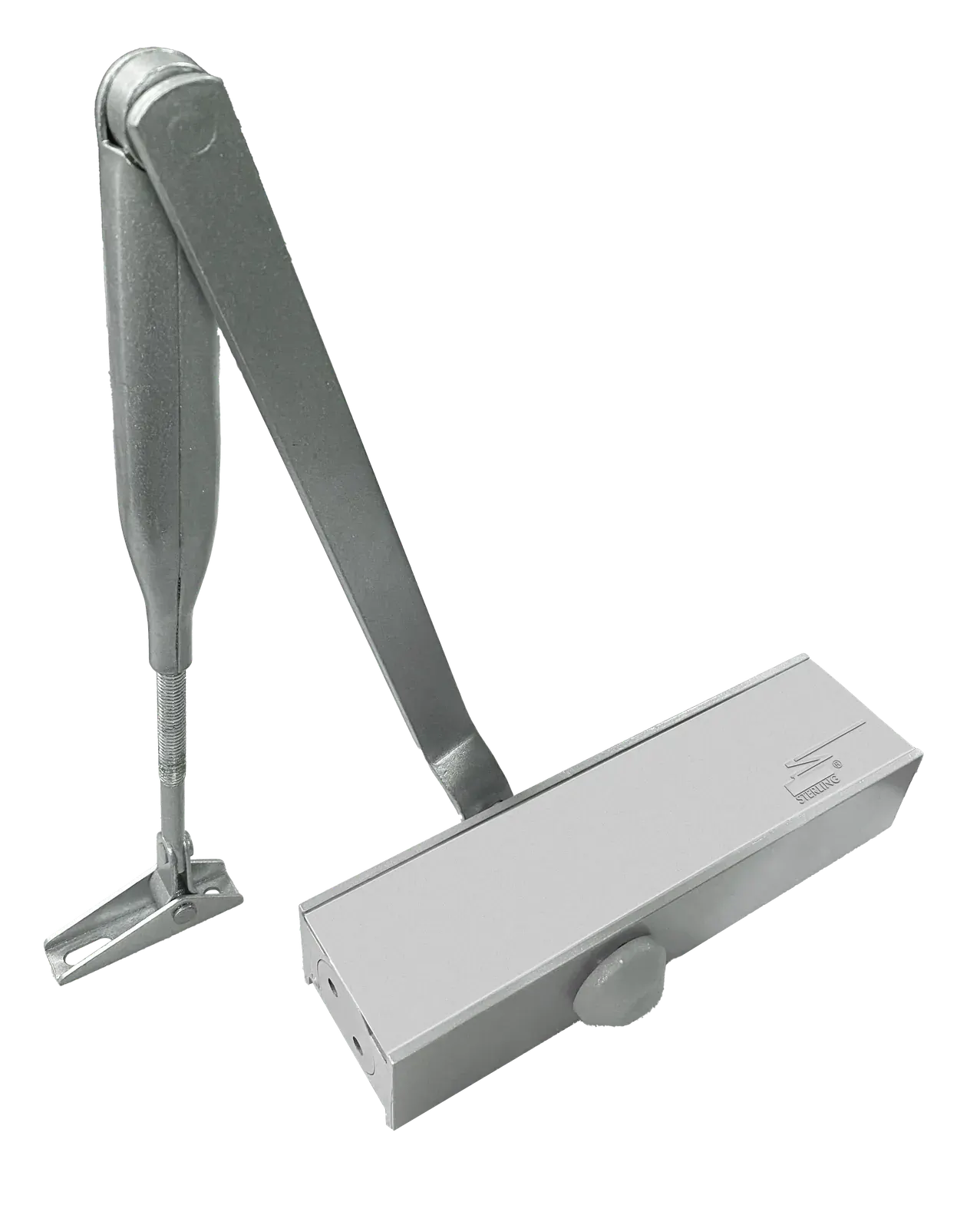
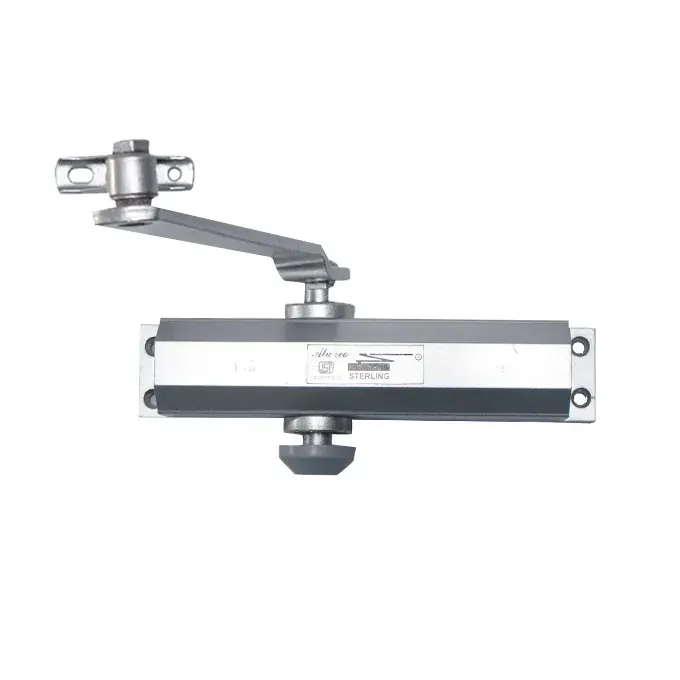
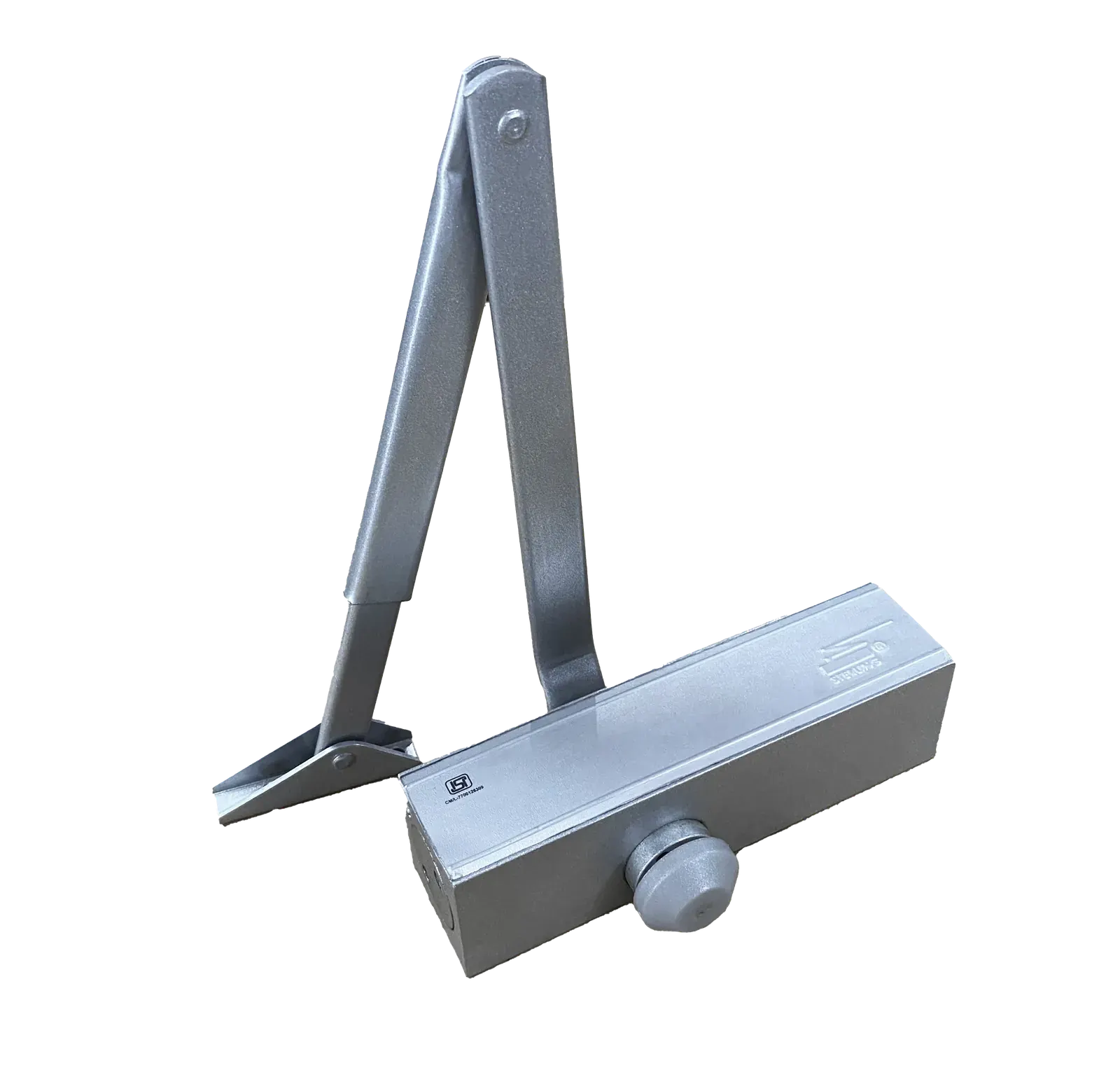
EN 1154 is the European standard for controlled door closing devices: overhead closers, concealed closers and floor springs that return a swing door to the closed position under hydraulic control. It sets requirements and test methods for closing force, opening force, speed adjustment, durability and corrosion resistance, and it defines the classification code that summarises the results.
Three levels of claim sit on top of it. A manufacturer can test to EN 1154, which produces results; classify a product, which turns a full set of results into the code; or, in the European market, CE mark it against EN 1154 as the harmonised standard, which needs a Declaration of Performance. A datasheet that quotes only a power size has made neither of the last two.
The six-digit code
The classification is written as six digits in a fixed order; a surface-mounted closer might read 4 8 3-5 1 1 3. The table gives each position and the grades the standard allows.
| Position | What it classifies | Grades |
|---|---|---|
| 1 | Category of use | 3: closes from at least 105 degrees. 4: closes from 180 degrees |
| 2 | Durability | 8: 5,00,000 test cycles, the only grade defined |
| 3 | Power size | 1 to 7, shown as a range for an adjustable closer |
| 4 | Fire and smoke door suitability | 0: not suitable. 1: suitable |
| 5 | Safety | 1: the only grade |
| 6 | Corrosion resistance | 0 to 4, none to very high, tested to EN 1670 |
Digit by digit
Category of use. Grade 3 means the closer was tested closing the door from at least 105 degrees open, grade 4 from 180 degrees. It tells you whether the closer and its arm geometry suit a door that will be swung fully back against a wall. A mechanical hold-open is not graded here; it bears on the fourth digit.
Durability. One grade is defined, 8, meaning 5,00,000 opening and closing cycles with the closer still meeting its performance requirements at the end. Every classified closer therefore shows an 8 here. The digit says the test was passed, not by how much.
Power size. The third digit is the familiar EN size, 1 to 7, each defined by a test door of a given mass and width: EN 3 is a 60 kg door up to 950 mm wide, EN 4 an 80 kg door up to 1100 mm, EN 5 a 100 kg door up to 1250 mm. An adjustable closer shows a range here, such as 3-5. The full table, and how to size against a door you already have, is in the guide to EN power sizes.
Fire and smoke door suitability. Grade 1 means the closer met the additional requirements for closers on fire and smoke doors, for which the standard sets power size 3 as the minimum; a closer with a mechanical hold-open is not graded for fire or smoke door use. Grade 0 means it was not assessed or did not qualify. This is a classification of the closer, not a fire test of the door assembly.
Safety. One grade, 1, which every classified closer must meet. The digit carries no information between products.
Corrosion resistance. Graded 0 to 4 by salt spray exposure under EN 1670: 0 is no defined resistance, 1 mild, 2 moderate, 3 high and 4 very high. For a coastal site, an external door or a wash-down area it is the digit to read first.
A worked example
Read 4 8 3-5 1 1 3 left to right: tested closing from 180 degrees; passed 5,00,000 cycles; adjustable across power sizes 3 to 5, so rated for doors up to 100 kg and 1250 mm; suitable for fire and smoke doors; meets the safety requirement; high corrosion resistance.
Where the Sterling data meets the code
Sterling publishes its door closers in EN 1154 terms for the power size, with the door mass and width each model is rated for, from EN 1-2 on the DC 1500 to EN 4-5 on the DC 2900. Each model's band, mass and width are listed in the model by model guide to the Sterling range.
Two points follow. First, where the published door limits and the EN band disagree, specify against the lower of the two and ask Sterling which governs. The DC 2900 is published for doors up to 1100 mm although EN 5 runs to 1250 mm; the DC 1500 is published for 45 kg and 900 mm although EN 2 ends at 40 kg and 850 mm; the DC 2700 is published for 970 mm although EN 3 ends at 950 mm. Second, the floor springs are published by door mass rather than EN size, the FS 1000 for 60 to 80 kg doors and the FS 3000 for 90 to 120 kg, both up to 1100 mm wide. If a schedule asks for an EN size equivalent for a floor spring, ask for it rather than inferring one from the mass.
On durability, the EN 1154 cycle test figure is 5,00,000 cycles, and five Sterling models are tested up to that figure in a government-approved lab: the DC 2000, DC 2600 and DC 2900 door closers and both floor springs. The DC 1800 LA, DC 1820 and DC 2800 are tested to 4,00,000 cycles and the DC 2700 to 3,00,000; the DC 1500 has no published cycle figure. The guide to door closer service life turns a cycle figure into years for a given door. A cycle test result is not a six-digit classification, and no EN 1154 classification or certificate is published for any Sterling model.
On marking, five models are CE marked: DC 1800 LA, DC 1820, DC 2000, DC 2600 and DC 2900. Sterling does not publish which standard or declaration the CE marking was issued against, so do not read it as an EN 1154 classification; if a project relies on it, ask Sterling for that model's Declaration of Performance. Separately, all eight door closers are ISI marked to IS 3564:1995 under BIS licence CM/L 7700126309 (DC 1500, DC 1800 LA, DC 1820, DC 2000, DC 2600, DC 2700, DC 2800 and DC 2900), and the floor springs are BIS certified under CM/L 7700249814. Those are Indian certifications, covered in the guide to ISI marking and IS 3564; they are not EN 1154 classifications and should not be written up as one.
What the published data does not include is a six-digit code, a category of use grade, a fire door grade or a corrosion grade. If a tender calls for any of those, ask for the document that carries them, a Declaration of Performance or a test report, rather than filling in digits from the power size band. Otherwise specify the published band, mass, width and cycle figure, which is what the Sterling door closer range is sold on. A clause that says only "EN 1154" is ambiguous: write whether you need a power size, a test result, a classification or a Declaration of Performance, and for a fire door ask the approving authority what evidence it accepts before you specify.
Questions
Is an EN power size the same as an EN 1154 classification?
No. The power size is the third digit of the six. A closer quoted as EN 3-4 has been sized on the standard's scale; the other five grades are only known if the full code is published.
What does the 8 in a door closer classification mean?
It is the durability grade, and 8 is the only one defined: 5,00,000 test cycles. Every closer classified to EN 1154 shows an 8 in the second position, so it confirms a pass rather than ranking one closer above another.
Can a closer with hold-open be used on a fire door?
Not with a mechanical hold-open, which EN 1154 does not grade for fire or smoke door use. Among Sterling products, the DC 2600 holds from 10 to 90 degrees, the DC 1820 is a hold-open pelmet arm model with no printed range, the concealed DC-2720 HPA and DC-2820 HPA variants hold from 10 to 90 degrees, the DC 1500 and DC 2900 have hold-open variants (DC-1520 HPA, DC-2920 HPA HD), and both floor springs hold at 90 degrees. None suits a door that must self-close every time, and no Sterling model is published with a fire door grade, so ask the fire consultant before specifying any of them on a fire or smoke door. Electrically released hold-open is covered by a different standard, EN 1155.