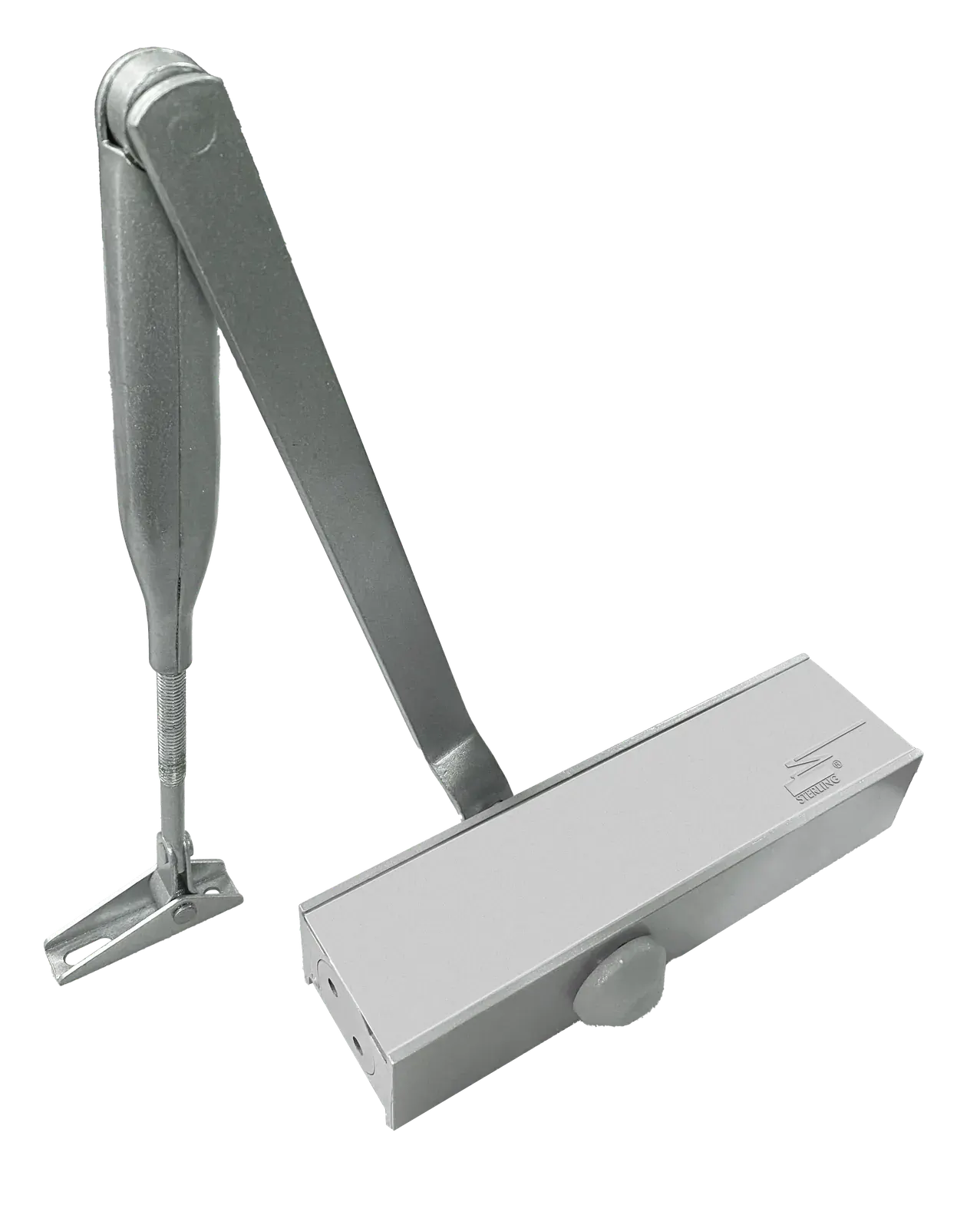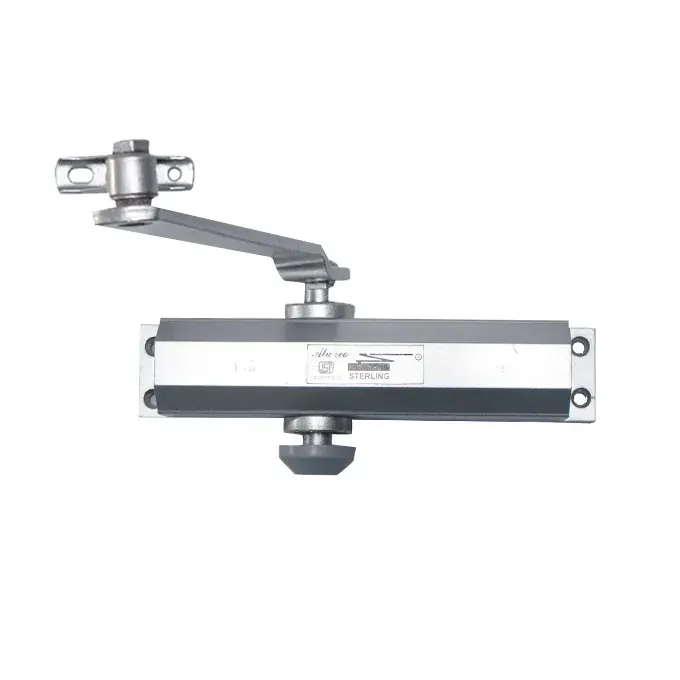
Preparing a door schedule for a door closer quote
Covers 10 columns
A quote is only as good as the schedule behind it. Ten columns per door give a supplier what it needs to size each leaf, match a model to it and return a quote you can compare line by line.
- Written by
- Sterling
- Published
- Updated
A door closer quote is built from a door schedule. Without one, a supplier can only price a guessed model, and the figure moves once the real doors are known. With one, each door is sized against its own width and mass and the quote comes back as quantities per model that can be checked against any other supplier's.
What a door schedule is, and what a quote needs from it
The architect's door schedule lists every door by reference number with its size, type, fire rating and ironmongery set. It often lacks what a closer quote needs: it gives a nominal door size but not the leaf mass, and rarely says whether a door is external or has to be held open. The hardware schedule described here is the subset a closer or floor spring supplier sizes against. If one exists, copy the door references across and add the missing columns.
The guide on how to measure a door before choosing a closer covers taking each figure; this one covers recording them.
The ten columns
| Column | What to record | Why it is needed |
|---|---|---|
| Door reference | The architect's door number, or your own | Ties the quote, delivery and installer to the same door |
| Leaf width and height | Both in mm; width from hinge edge to leading edge | Width sets the EN power size with mass; height is checked against published limits |
| Leaf mass | Leaf weight in kg, from the door maker's data or weighed | Sets the EN power size with width |
| Leaf thickness | In mm, measured at the edge | Decides whether a concealed closer fits |
| Material | Solid-core timber, hollow-core timber, aluminium framed, steel, frameless glass | Decides the product family and the fixing |
| Handing | Left or right hand, seen from the side the door opens away from, or double action (swings both ways, no hand) | Tells the installer how the body and arm are set out |
| Internal or external | Exposed to wind or stack pressure, or not | External doors are sized a power size up |
| Mounting | Surface on door, surface on frame, concealed, or floor spring | Decides the model and arm type |
| Hold-open needed | Yes or no, with the angle if it matters | Selects a hold-open variant |
| Quantity | Identical doors in that row | Becomes the quote line |
Notes on the columns that cause rework
Width and height. Record the leaf as the measuring guide above describes; the EN scale it is read against is in what size door closer do I need. Height matters because the DC 2000, DC 2600, FS 1000 and FS 3000 are published for doors up to 2100 mm high; ask the supplier about any leaf taller than that.
Mass. Use the door maker's leaf data or weigh the leaf, as the measuring guide sets out. Failing both, write the construction in the material column, mark the mass as to be confirmed and ask the supplier to flag those doors and state the mass it sized them for.
Thickness and material. Thickness decides whether a concealed closer can fit: the Sterling DC 2700 suits wooden doors from 32 mm thick and the DC 2800 wooden doors from 38 mm. Frameless glass has nothing to screw a closer to and runs on a floor spring. A hollow-core flush door takes a surface closer only with a backing plate or timber insert behind it.
Handing. Record a hand for every leaf, including both leaves of a pair; the measuring guide explains why it rarely changes the model.
Internal or external. An external door has to latch against wind and stack pressure, so its closer is usually sized up: a leaf near the top of EN 3 is often quoted on a model reaching EN 4, such as the DC 2000 (EN 3-4, up to 80 kg and 1100 mm wide).
Mounting. If you have no preference, write surface and let the supplier propose. The DC 1500 and DC 2000 are listed for on-door and on-frame installation. Concealed and floor-recessed mounting need door or floor preparation that changes the installed cost, which what affects door closer price in India covers.
Hold-open. On door closers, hold-open is a separate model or arm variant, so the supplier needs it before quoting: the DC 2600 holds the door open from 10 to 90 degrees and the DC 1820 is a hold-open pelmet arm model. Both floor springs have hold-open built in at 90 degrees.
Optional columns worth adding
- Fire or smoke door. A fire door must not be held open without an arrangement the project's fire consultant has approved, so mark these and leave the hold-open decision with them.
- Certification required. If the project calls for ISI marked closers, say so. All eight Sterling door closers are ISI marked to IS 3564:1995 under BIS licence CM/L 7700126309, five (DC 1800 LA, DC 1820, DC 2000, DC 2600 and DC 2900) are CE marked, and the floor springs are BIS certified under CM/L 7700249814.
- Finish. Sterling door closers, surface-mounted and concealed, come in silver, black, brown, gold and rose gold, and the floor springs with a stainless steel matt top plate.
Template layout, and an example
One row per door, each with its reference, is easy to check on site. One row per door type with a quantity is shorter and is the form the quote comes back in. On a large project, group doors into types but list the references each type covers, so nothing drops out. Date the schedule and give it a revision number, so the quote can say which revision it was priced against.
Two illustrative rows:
- G-01 to G-12: 800 mm wide, 2100 mm high, 32 kg, 40 mm, solid-core timber, left hand, internal, surface on door, no hold-open, quantity 12.
- G-20: 1000 mm wide, 2000 mm high, 65 kg, 12 mm, frameless glass, double action, external, floor spring, hold-open at 90 degrees, quantity 1.
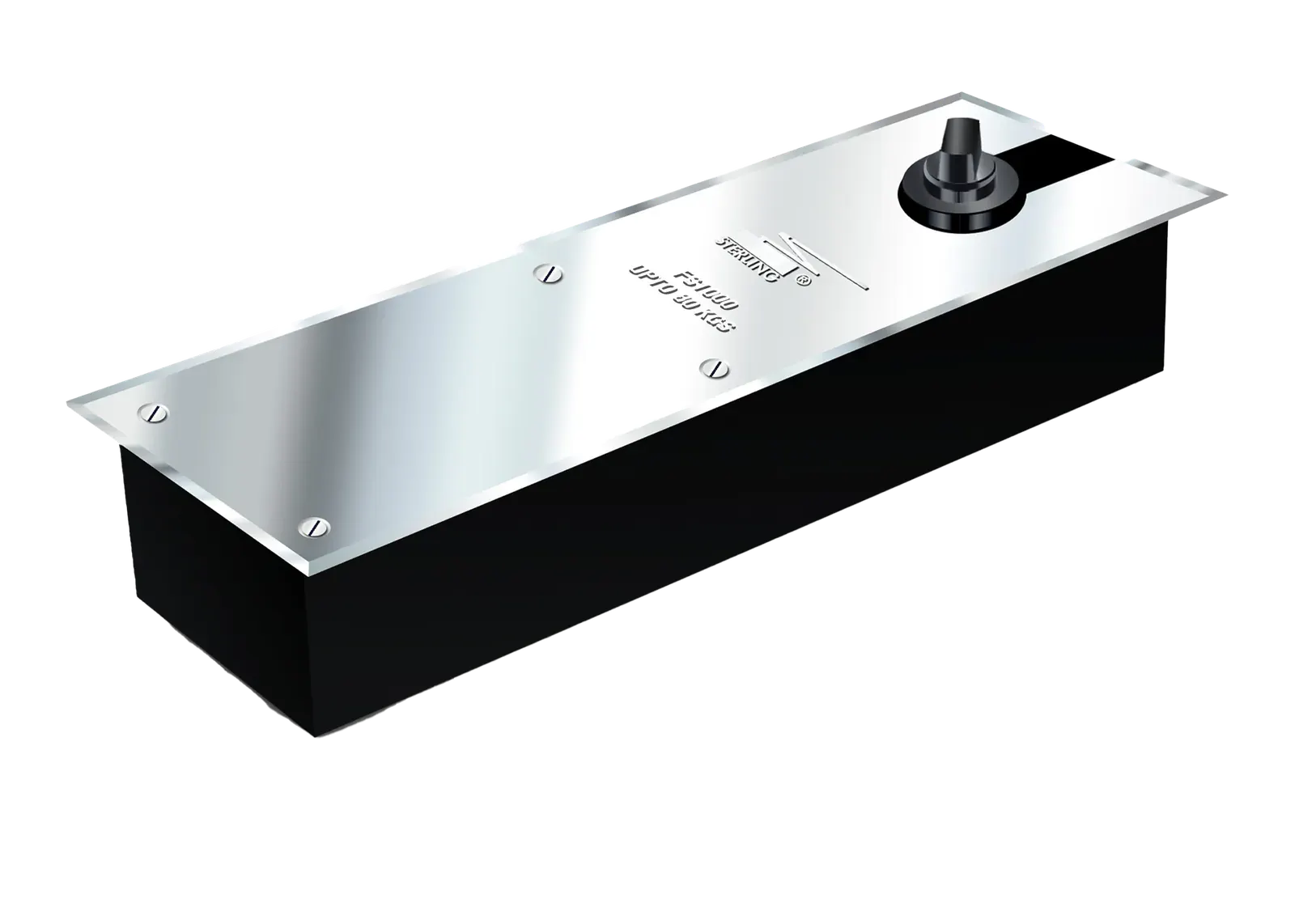
The first is EN 2 on width and mass, clear of the 850 mm and 40 kg limits, and sizes to a light surface closer such as the DC 1500, which covers EN 1-2 for doors up to 45 kg and 900 mm; a door exactly on a limit would get a model whose range reaches the next size up. The second is a floor spring job: a glass door of that mass sits inside the 60 to 80 kg range of the FS 1000, rated for wooden and glass doors up to 1100 mm wide and 2100 mm high, with a built-in hold-open at 90 degrees. Sterling floor springs have no published EN power size, so an external leaf is checked against the rated mass band rather than sized up.
What happens when the schedule is sent
The supplier reads width and mass against the EN scale, confirms the family from material, thickness and mounting, picks hold-open variants where asked, and groups the result into quantities per model and finish. Some doors fall outside the range: a surface-mounted leaf above 100 kg is beyond the DC 2900, the upper end of the Sterling surface-mounted range, and a glass leaf above 120 kg is beyond the FS 3000. A floor spring leaf under 60 kg, or above 80 kg and under 90 kg, sits outside both rated ranges, and a leaf wider than 1100 mm is beyond every Sterling model.
Ask for three things with the quote: that each line names the door references it covers, the accessories each line needs (pivot sets for a floor spring on a wooden door), and the installation guides for the models proposed. Sterling does not publish list prices, because price depends on model, finish and quantity, and this site does not publish lead times or warranty terms, so ask for all three when you send the schedule.
Where to send it
The message field on the quote form on the contact page has a length limit and suits a couple of dozen rows: paste them in with the project name and the date the hardware is needed. Email anything longer, or a spreadsheet, with the same details to the address listed beside the form. The door closers and floor springs pages carry the rated width, mass and mounting for each model.
Questions
Is a door schedule the same as a door hardware schedule?
Not quite. The architect's door schedule lists every door with its size, type and fire rating; the hardware or ironmongery schedule lists the fittings each door gets.
What if I do not know the door mass?
Ask the door manufacturer for the leaf data, or weigh the leaf before it is hung. Failing both, record the construction and thickness and mark the mass as to be confirmed rather than guessing.
How do I record double doors?
As two leaves. Each has its own width, mass and hand, and each needs its own closer, so a pair is a quantity of two. If the leaves are unequal, give each its own row.